

Most company files in Dubai don't get stuck on the big decisions. They get stuck on a passport with five months left on it, a phone photo of a certificate with one corner cut off, or a parent company's board resolution that was apostilled in London and then turned away in Dubai. The founder did the hard part, choosing the activity and the jurisdiction, and then lost two weeks to paperwork.
The document list itself isn't long. What trips people up is that it changes depending on three things: where you set up (mainland, free zone or offshore), who owns the company (a person or another company), and whether that owner already lives in the UAE. Most guides give you one flat list and leave you to work out which parts apply.
This guide splits it properly. You'll see what you have to supply, what the authority produces for you, how foreign documents get legalised for the UAE (including a shortcut that other guides recommend and that doesn't work here), and the checklist we use before a file goes in. If you haven't picked a structure yet, read how to start a business in Dubai first, because the structure decides the paperwork.
What documents do you need to set up a business in Dubai?
For an individual shareholder, the core pack is a passport copy valid for at least six months, a passport photo on a white background, three trade name options, your chosen business activities, and proof of an address for the company. UAE residents add their visa and Emirates ID.
That's the pack for a single foreign owner setting up a simple trading or consultancy company. Everything else in this article is an addition to it, triggered by a specific situation:
- Passport copy for every shareholder and the appointed manager, in colour, with at least six months of validity left.
- Passport-size photo on a plain white background, recent and not a cropped selfie.
- Residence visa and Emirates ID if you already live in the UAE, or a copy of your last entry stamp or visit visa if you're in the country without residency.
- Three trade name options in order of preference.
- Business activities picked from the authority's activity list, not described in your own words.
- Company address: an Ejari-registered tenancy contract for mainland, or the free zone's lease or flexi-desk agreement.
You don't need a UAE national partner for most activities since the 2021 foreign ownership reforms.
Which documents do you supply, and which does the authority issue?
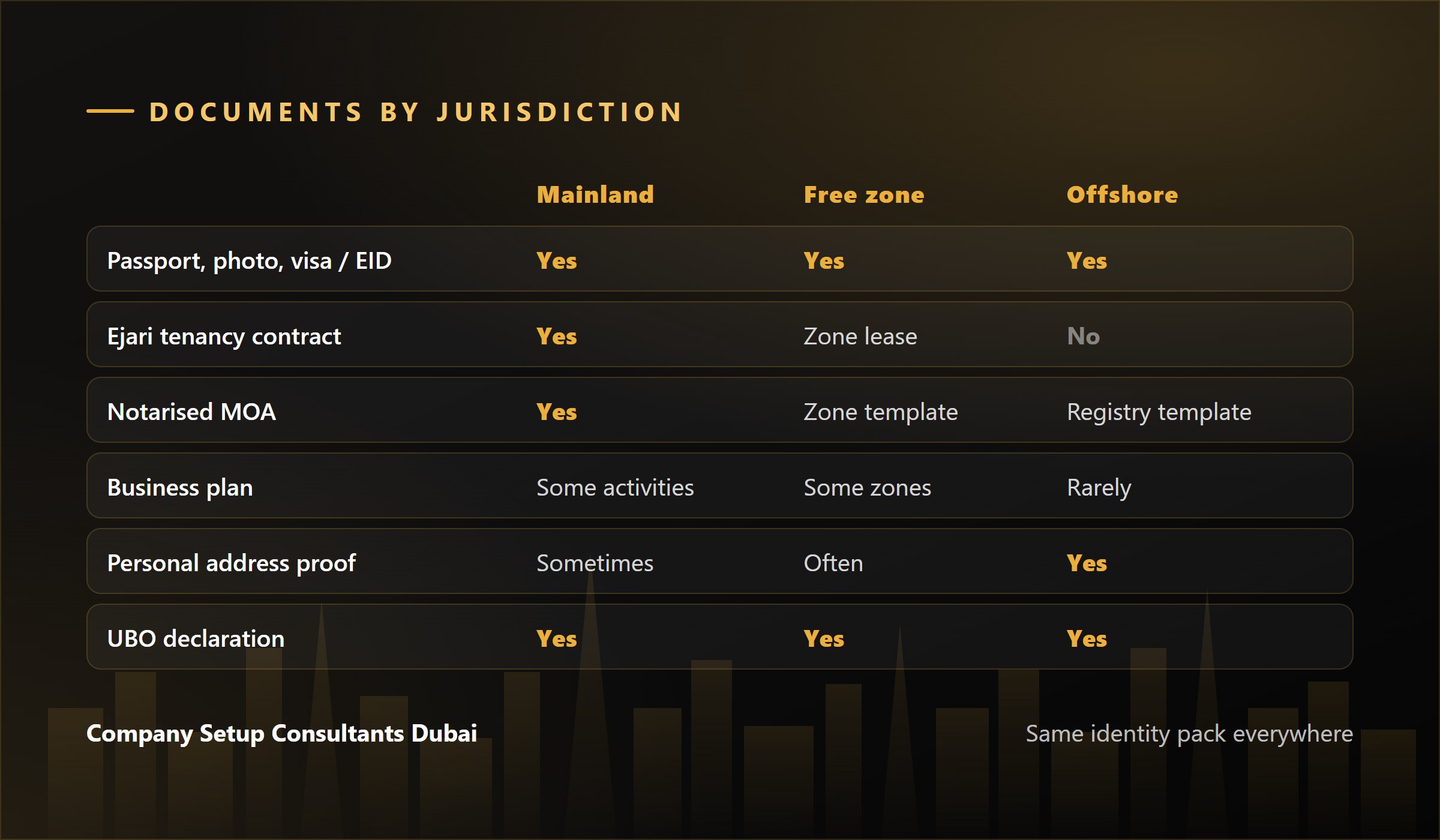
You supply identity documents, name choices, activities and, for corporate shareholders, the parent company's papers. The authority issues the trade name reservation, initial approval, MOA (on mainland), licence, and establishment card. Knowing the split stops you chasing documents nobody expects from you.
Most competitor checklists mix the two piles together, which is why founders sometimes try to "get" an initial approval before they apply. You can't. It's an output of the application, not an input. Here's the order things actually arrive in:
| Document | Who produces it | When |
|---|---|---|
| Passport, photo, visa and Emirates ID copies | You | Before you apply |
| Trade name options and activity list | You | Before you apply |
| Parent company documents (corporate shareholders) | You, legalised abroad | Before you apply, often the longest wait |
| Trade name reservation certificate | Licensing authority | First day or two |
| Initial approval | Licensing authority | After the name is reserved |
| Memorandum of Association | Authority template, signed by shareholders | After initial approval |
| Tenancy contract and Ejari (mainland) | Landlord, registered with DLD | Before the licence is issued |
| Trade licence | Licensing authority | Once fees are paid |
| Establishment card | Immigration (GDRFA or ICP) | After the licence |
The Ministry of Economy and Tourism's own company establishment guide lists the final submission the same way: the initial approval and everything already filed, an attested lease contract, the Memorandum of Association where required, and any extra approvals from other government bodies.
How do the documents differ for mainland, free zone and offshore?
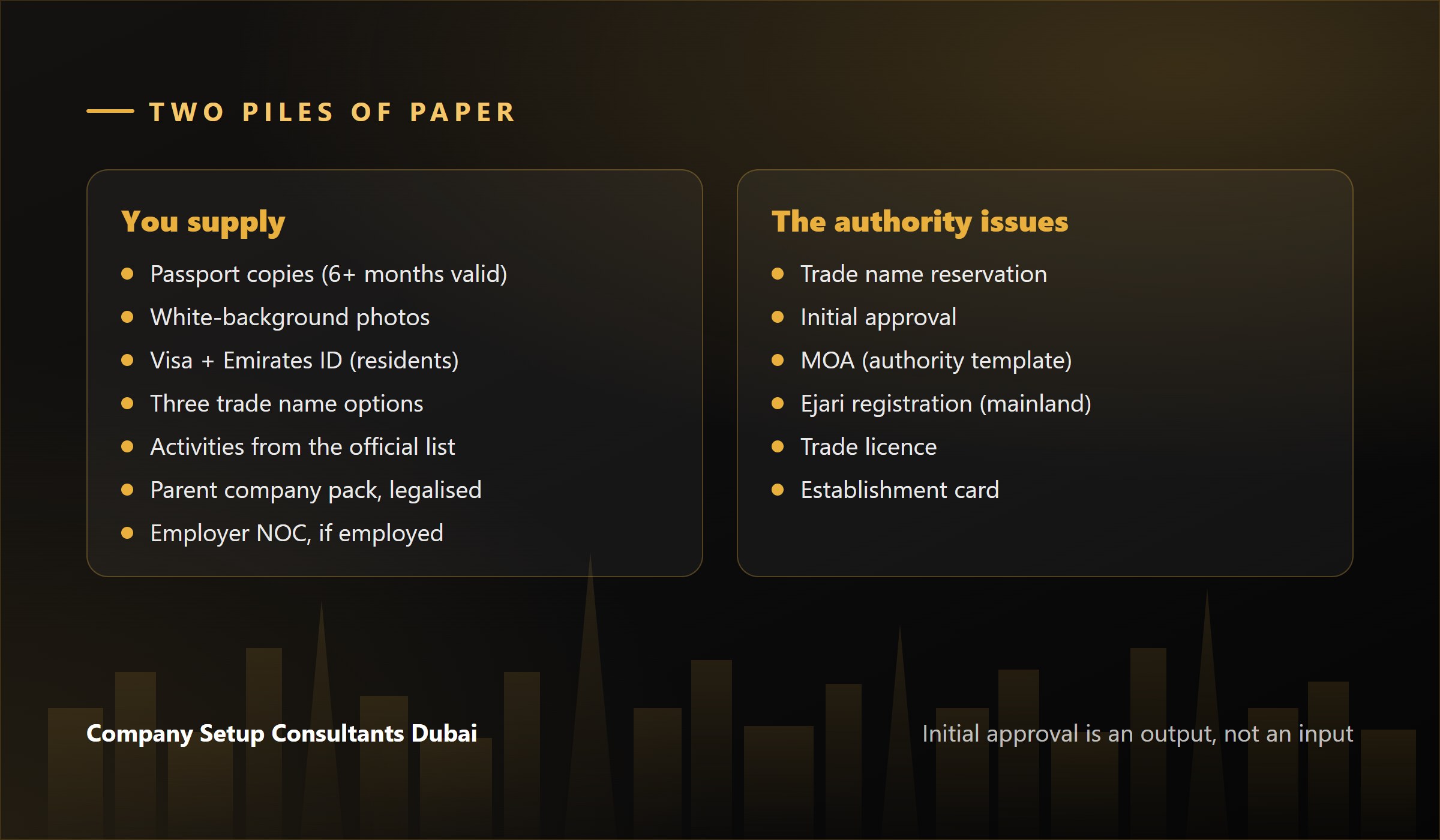
Mainland adds an Ejari tenancy contract and a notarised MOA. Free zones replace Ejari with their own lease and often ask for an application form, specimen signatures and sometimes a business plan. Offshore needs no office lease but asks for more detailed KYC and a structure chart.
The core identity pack is the same everywhere. The differences sit in the address, the constitutional documents and how much ownership detail the registrar wants up front. If you're still weighing the three, our mainland vs free zone vs offshore comparison covers cost and trading rights. On paperwork alone, it looks like this:
| Document | Mainland (DET) | Free zone | Offshore |
|---|---|---|---|
| Passport and photo | Yes | Yes | Yes |
| Visa and Emirates ID (residents) | Yes | Yes | Yes |
| Proof of personal address | Sometimes | Often | Yes, recent utility bill |
| Ejari tenancy contract | Yes | No, zone lease instead | No |
| Notarised MOA | Yes | Zone template, usually e-signed | Registry template |
| Application form and specimen signatures | Online via Invest in Dubai | Yes | Yes |
| Business plan | Only for some activities | Some zones | Rarely |
| Bank reference or CV | No | Some zones | Often |
| UBO declaration | Yes | Yes | Yes |
On the mainland, the tenancy contract holds up most files, and it's also where most of the business setup cost sits. Our Dubai mainland setup and Dubai free zones pages list what each route needs in practice.
What changes if you already live in the UAE?
Residents add a copy of their residence visa and Emirates ID, and if they're employed on another company's visa, they usually need a No Objection Certificate from that employer. Non-residents supply a passport copy and, where asked, their last entry stamp, and can often complete everything remotely.
The NOC catches people out more than anything else on this list. If your residence visa is sponsored by an employer, many free zones won't register you as a shareholder or manager without a letter from that employer confirming they don't object. Get it on company letterhead, signed and stamped, naming you and your passport number.
Non-residents can usually get the licence before they ever land, since free zones and offshore registries work online. On the mainland, the MOA signing before a notary can be handled through a legalised power of attorney or remote notarisation where allowed. Your residency then comes later, through the UAE investor visa once the company exists.
What extra documents does a corporate shareholder need?
A company owning a Dubai company must supply its certificate of incorporation, memorandum and articles, a board resolution approving the investment and naming a representative, a recent certificate of good standing, its shareholder and director registers, and a power of attorney, all legalised for UAE use.
This part takes weeks, not days, because every paper is issued abroad and then legalised. A typical parent company pack:
- Certificate of incorporation (or registration) of the parent company.
- Memorandum and articles of association, or the equivalent constitutional document.
- Board resolution approving the new UAE company, its capital, its activities and the person who will sign for the parent.
- Certificate of good standing or incumbency, issued recently. Most registrars won't accept one older than three to six months.
- Register of shareholders and directors, so the chain of ownership can be followed.
- Power of attorney for the individual who will sign the MOA and deal with the authority.
- Passport copies of the parent's directors and of every person who ultimately owns 25% or more.
Order the good standing certificate last. It's the document most likely to expire while the others are at the embassy.
How does attestation work for foreign documents?
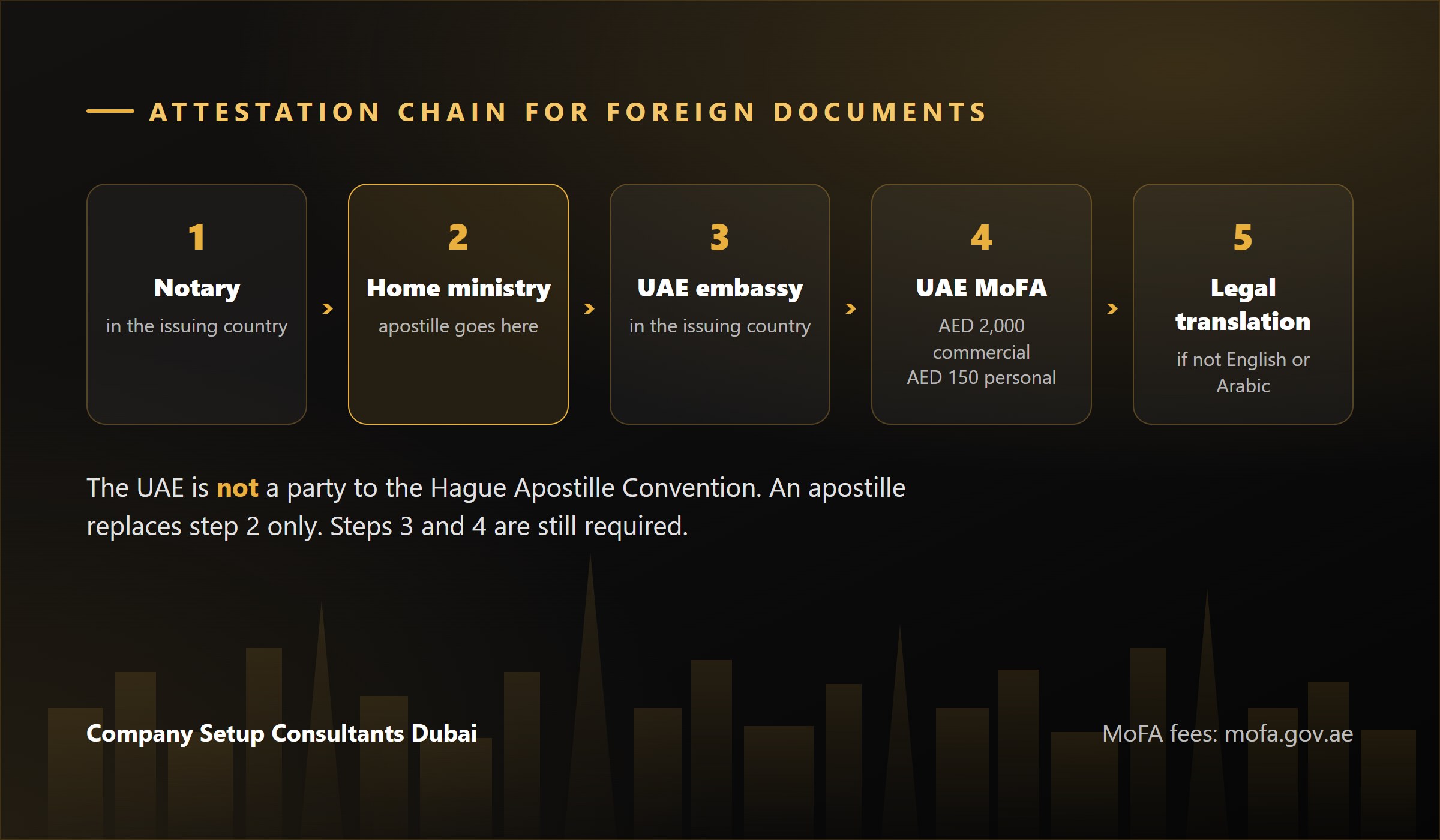
Foreign documents go through a chain: notarised in the country of issue, certified by that country's foreign ministry, legalised by the UAE embassy there, and then attested by the UAE Ministry of Foreign Affairs. An apostille alone isn't accepted, because the UAE hasn't joined the Apostille Convention.
This is where a lot of published advice is wrong. Several popular checklists say that documents from Apostille Convention countries can skip the embassy step with a single apostille. That only works when both countries are parties to the convention, and the UAE isn't one. It doesn't appear on the HCCH status table for the Apostille Convention, while neighbours like Saudi Arabia, Oman and Bahrain do. A parent company in the UK or the US can get an apostille, but that apostille is just the home-country step. The UAE embassy and the UAE Ministry of Foreign Affairs still have to stamp it.
The full chain, in order:
- Notarisation by a notary public in the country where the document was issued.
- Home-country certification by the foreign ministry or the designated authority (in apostille countries, this is where the apostille goes).
- UAE embassy or consulate legalisation in that country.
- UAE Ministry of Foreign Affairs attestation once the document is in the UAE, done online through MoFA's portal or app.
- Legal translation into Arabic by a UAE-licensed translator if the original is in neither Arabic nor English.
The last UAE step has a published price. According to the UAE Ministry of Foreign Affairs, attestation costs AED 150 for personal documents and AED 2,000 for commercial documents, with courier delivery at AED 40 for three working days or AED 150 for next day. A board resolution, a good standing certificate and a certificate of incorporation are three commercial documents, so that's AED 6,000 at MoFA alone before any home-country or embassy fees. Ask the free zone upfront which documents it genuinely needs legalised.
What is the UBO declaration, and when is it due?
Every UAE company must record the natural persons who own or control 25% or more of it in a beneficial owner register, under Cabinet Decision No. 109 of 2023. The register is due within 60 days of the company's creation, and any change must be recorded within 15 days.
Most authorities collect the UBO details during the application. What you need:
- Full name, nationality, date and place of birth, and residential address of each beneficial owner.
- Passport copy of each beneficial owner, and Emirates ID for residents.
- How ownership or control is held: directly, through another company, or through a right to appoint most of the directors.
- A structure chart that follows every corporate layer down to a person, not a company.
The rule reaches through layers. If a holding company owns your Dubai company, the decision looks at who owns the holding company, and so on until a human being appears. Nominee directors have to declare themselves too. The same register comes up again when you open the account, which is covered in our guide to opening a corporate bank account in the UAE.
What documents do you receive once the licence is issued?
You receive the trade licence, the final MOA or articles, a certificate of incorporation or commercial register extract, share certificates in most free zones, and the establishment card. Together they're the company's identity pack for visas, banking, tax registration and every future renewal.
| Document | What you use it for |
|---|---|
| Trade licence | Proof the company exists and what it may do. Renewed every year. |
| MOA / articles of association | Ownership, capital, the manager's powers. Banks read it closely. |
| Certificate of incorporation / register extract | Company registration details for banks and foreign partners. |
| Share certificates | Evidence of each shareholder's stake (mainly free zones). |
| Establishment card | Unlocks visa applications for owners and staff. |
| Lease and Ejari | Address proof, visa quota, and renewals. |
Scan them the day they arrive. You'll need them again for the corporate tax registration, the bank account and the first visas. If you'd rather not coordinate those yourself, our bank account assistance service picks up from the licence.
Which activities need extra approvals and documents?
Regulated activities need a second approval from the body that governs the sector, with its own document list. Healthcare, education, food, transport, security, financial services and some engineering activities are the common ones, and the extra approval usually comes between initial approval and the licence.
The authority flags affected activities when you select them. Typical extras:
- Healthcare: the health authority's facility approval, staff professional licences and floor plans.
- Education and training: the education regulator's approval and instructors' qualifications.
- Food and restaurants: municipality food safety approval and a kitchen layout.
- Transport, car rental, fire and safety equipment: Ministry of Interior or roads authority approvals.
- Financial services: a regulator's authorisation, a business plan and fit-and-proper documents for managers.
Some sectors are simpler in a free zone with an in-house regulator for that industry.
What mistakes get a document pack sent back?
Most rejections come from small, avoidable problems: passports under six months, photos on the wrong background, apostille-only foreign documents, names spelled differently across papers, outdated good standing certificates, and ownership charts that stop at a company instead of a person.
These are the ones we see most often when checking files before they go in:
- Passport validity under six months. Renew first. The visa stage will reject it later anyway.
- Poor scans. Cropped corners, glare over the photo page, or black-and-white copies of a colour passport.
- Name mismatches. "Mohammed" on the passport and "Muhammad" on the board resolution is enough to stop a file. Use the passport spelling everywhere.
- Apostille treated as final. The embassy and MoFA stamps are still missing.
- Stale corporate documents. A good standing certificate from last year won't pass.
- An incomplete UBO chain that ends at a holding company.
- Missing employer NOC for a shareholder who's employed in the UAE.
- Activity descriptions in your own words instead of the authority's activity codes.
A clean file usually moves from application to licence in a few working days in a free zone and one to two weeks on the mainland. A file with one of the problems above can easily double that, and legalising foreign corporate documents can take several weeks on its own. Start that chain first.
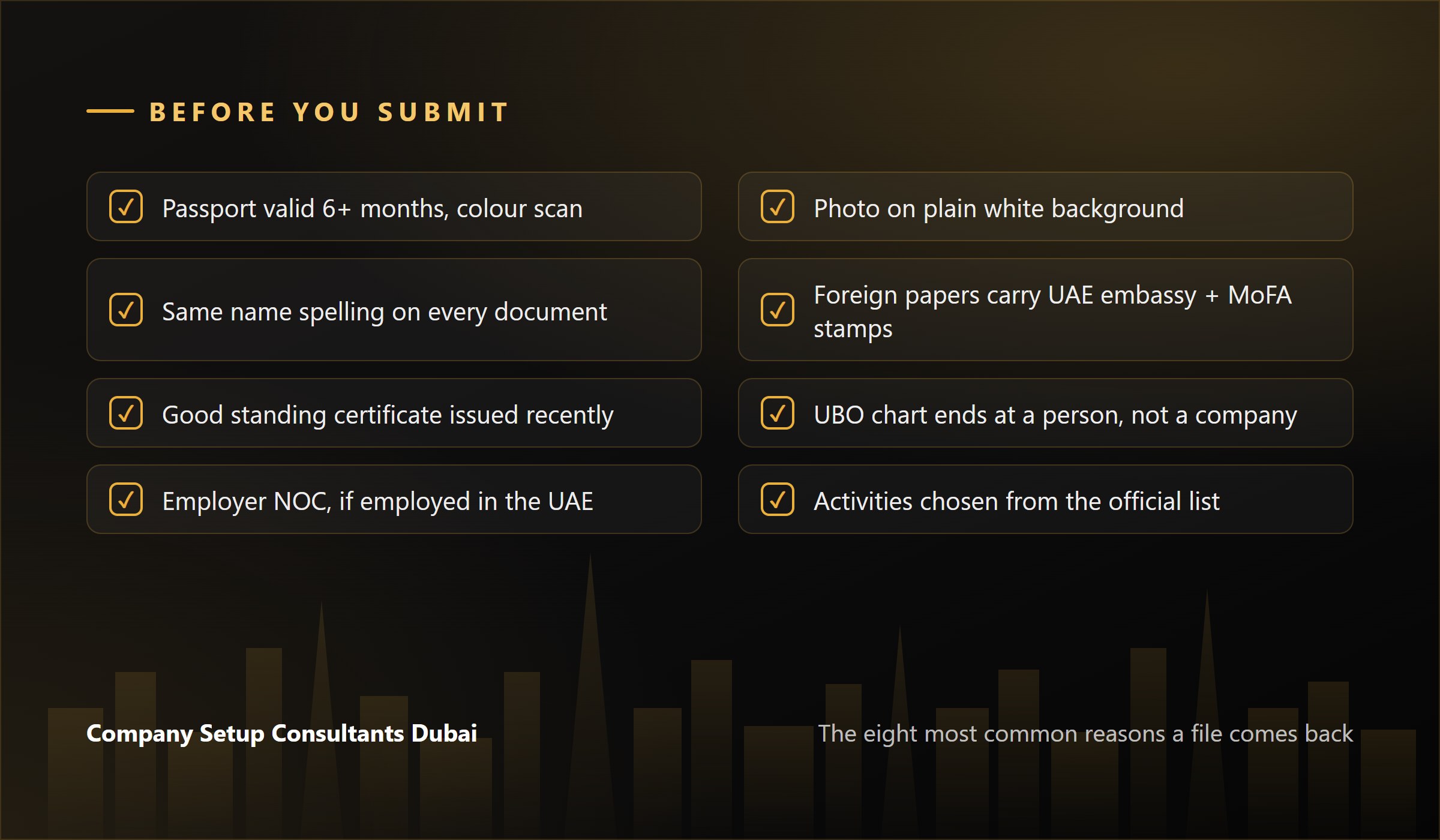
What does the complete checklist look like?
For one individual owner on a Dubai mainland or free zone licence, the full checklist is about ten items. Corporate shareholders add the legalised parent company pack. Tick everything below before you submit and the licensing stage is rarely the slow part.
- Colour passport copy, six months or more of validity, for each shareholder and the manager
- White-background passport photo for each
- Residence visa and Emirates ID (residents), or last entry stamp (non-residents, if asked)
- Employer NOC, if employed in the UAE on another sponsor's visa
- Three trade name options
- Activities selected from the authority's list
- Ejari tenancy contract (mainland) or zone lease or flexi-desk agreement (free zone)
- UBO declaration and a one-page structure chart
- Parent company pack, legalised through UAE MoFA (corporate shareholders only)
- Sector approvals and their documents (regulated activities only)
- Specimen signatures, and an MOA signed before a notary in person or through a power of attorney (mainland)
If you'd like someone to check the pack before it's submitted, our Dubai LLC setup team does this as part of every mainland file, and we handle offshore files through the offshore company formation service. You can also just send us your list through the contact page and we'll tell you what's missing.
Frequently Asked Questions
Can I set up a company in Dubai without a UAE visa?
Yes. Non-residents can own and register a company with a passport copy and, where asked, a copy of their last entry stamp or visit visa. Most free zones and offshore registries run fully online, and a mainland MOA can be signed through a notarised power of attorney.
Do I need a business plan to register a company in Dubai?
Not for most licences. Some free zones ask for a short business plan with the application, regulated activities such as healthcare or education need one for the regulator, and banks almost always want one before they open the corporate account.
Is Ejari required for a free zone company?
No. Ejari is the Dubai Land Department system for mainland tenancy contracts. A free zone company gets a lease or flexi-desk agreement issued by the free zone authority itself, and that agreement is the address document for the licence and visa quota.
Can I use an apostille instead of UAE embassy attestation?
No. The UAE is not a party to the Hague Apostille Convention, so an apostille on its own is not accepted for use in the UAE. Foreign documents still go through home-country legalisation, the UAE embassy and then the UAE Ministry of Foreign Affairs.
How many trade name options should I submit?
Submit three, in order of preference. Names that repeat an existing licence, use a religious or political term, or include a family name that isn't a shareholder's are the usual rejections, and a spare option saves you a second round.
Do I need a No Objection Certificate from my employer?
If you already work in the UAE on someone else's visa, expect to need one. Many free zones ask for it directly, and your employment contract may prohibit outside business without written consent, which the NOC provides. Business owners on their own investor visa don't need it.
Do my documents need to be translated into Arabic?
Documents in English or Arabic are usually accepted as they are. Anything in another language needs a translation by a UAE-licensed legal translator after attestation. A Dubai mainland MOA is issued in Arabic and English, so the authority handles that one.


