

Walk into any Amer centre in Dubai on a weekday morning and you'll see the same two queues. One is company owners renewing a two-year investor visa for the third or fourth time. The other is people holding a nomination letter, waiting to swap that routine for a ten-year UAE Golden Visa. Same people, five years apart. The difference between the queues is usually a decision the founder made, or didn't make, when the company was first set up.
The Golden Visa stopped being a celebrity programme a while ago. Since January 2024, when the UAE dropped the AED 1 million minimum down payment for property investors (AGBI, 23 January 2024), the bar has been the same everywhere: AED 2 million of something the government recognises. For business owners, that "something" doesn't have to be an apartment. Company capital, share value, or the tax your company already pays can all get you there.
What follows covers the routes that apply to people who own or invest in a UAE business: what each requires, what it costs, how the application runs, and where founders trip up. Still deciding whether to set up at all? Start with our guide on how to start a business in Dubai and come back once the company is real.
What is the UAE Golden Visa, and why do business owners want it?
The UAE Golden Visa is a ten-year renewable residence permit that doesn't depend on an employer or a company sponsor. Business owners want it because it survives company changes, exempts them from the six-month absence rule, and lets them sponsor family for the whole ten years.
Under the standard route, your residency belongs to your company. Your company holds the establishment card, the visa is drawn against the company's quota, and if the licence lapses, so does your right to be here. We explained that chain in detail in the guide to the UAE investor visa. The Golden Visa cuts that chain. You become your own sponsor.
The legal basis is Cabinet Resolution No. 65 of 2022, the executive regulations of the federal entry and residence law, which set the investor, entrepreneur and talent categories. Two authorities issue it. The Federal Authority for Identity, Citizenship, Customs and Port Security (ICP) handles applications federally and in every emirate except Dubai. In Dubai, the General Directorate of Residency and Foreigners Affairs (GDRFA) runs it, with the Dubai Land Department fronting the property route.
And yes, it is a residence permit, not citizenship and not a passport. Ten years of it doesn't lead to naturalisation. Anyone selling you a "path to a UAE passport" is selling something else.
What does a Golden Visa give you that an investor visa doesn't?
A Golden Visa gives you ten years instead of two, self-sponsorship instead of company sponsorship, exemption from the rule that cancels residency after six months abroad, family sponsorship regardless of children's age, and unlimited domestic worker sponsorship. Your family also keeps their residency if you die.
The practical differences matter more than the headline number:
- No six-month rule. A standard residence permit is cancelled after 180 days abroad in one stretch. Golden Visa holders are exempt, as GDRFA Dubai states on its service page. For a founder who runs sales from London or Mumbai half the year, this alone justifies the upgrade.
- Separation from the company. Restructure, sell, merge or close the company and your residency stays put. On an investor visa, closing the company means cancelling the visa within 30 days.
- Family for the full term. Spouse, children of any age, and parents can be sponsored, and their permits match yours. Under the two-year visa, sons age out at 25.
- Fewer renewals. One renewal a decade instead of five, each of which is a medical, a biometrics appointment and roughly AED 4,700 to 7,000.
- Staff sponsorship. Golden Visa holders can sponsor an unlimited number of domestic workers.
What it doesn't do is replace your trade licence. Your company still needs its licence renewed, its establishment card current, and its corporate tax and VAT filings done. The visa only changes who sponsors you. For a line-by-line comparison with the two-year visa, see the table in our investor visa guide.
Which Golden Visa routes are open to business owners and investors?
Four investor routes and three entrepreneur routes apply to business owners: AED 2 million in company capital or shares, AED 2 million in a fund or bank deposit, AED 250,000 in annual tax, AED 2 million in property, an SME with AED 1 million annual revenue, an incubator-approved innovative project, or a previous business sold for AED 7 million.
The federal portal at u.ae groups these under "investors" and "entrepreneurs". The two labels behave very differently in practice. Investor routes are about money you can prove on paper. Entrepreneur routes are about a business someone official has assessed and nominated. Investor applications go straight to ICP or GDRFA. Entrepreneur applications need a nomination letter first.
| Route | Threshold | Proof that counts | Validity | Nomination needed? |
|---|---|---|---|---|
| Company capital or shareholding | AED 2 million | Trade licence, commercial register showing capital and your share, audited accounts, bank confirmation | 10 years | No |
| Fund or bank deposit | AED 2 million | Letter from an accredited UAE fund or bank confirming the deposit, held at least 2 years | 10 years | No |
| Tax contribution | AED 250,000 per year for the 2 years before applying | Federal Tax Authority letter plus tax returns and receipts, in proportion to your shareholding | 10 years | No |
| Real estate | AED 2 million in property value | Title deed, valuation certificate, bank no-objection letter if mortgaged | 10 years | No (DLD in Dubai) |
| Entrepreneur: SME revenue | AED 1 million annual revenue | Licence, audited revenue, approval from the Ministry of Economy and Tourism or local authority | 5 years (federal); GDRFA Dubai lists 10 | Yes |
| Entrepreneur: innovative project | Project value from AED 500,000 | Letter from an approved incubator or authority confirming the project | 5 years (federal); GDRFA Dubai lists 10 | Yes |
| Entrepreneur: prior exit | Previous project sold for AED 7 million or more | Sale documentation, approval from the Ministry or local authority | 5 years (federal); GDRFA Dubai lists 10 | Yes |
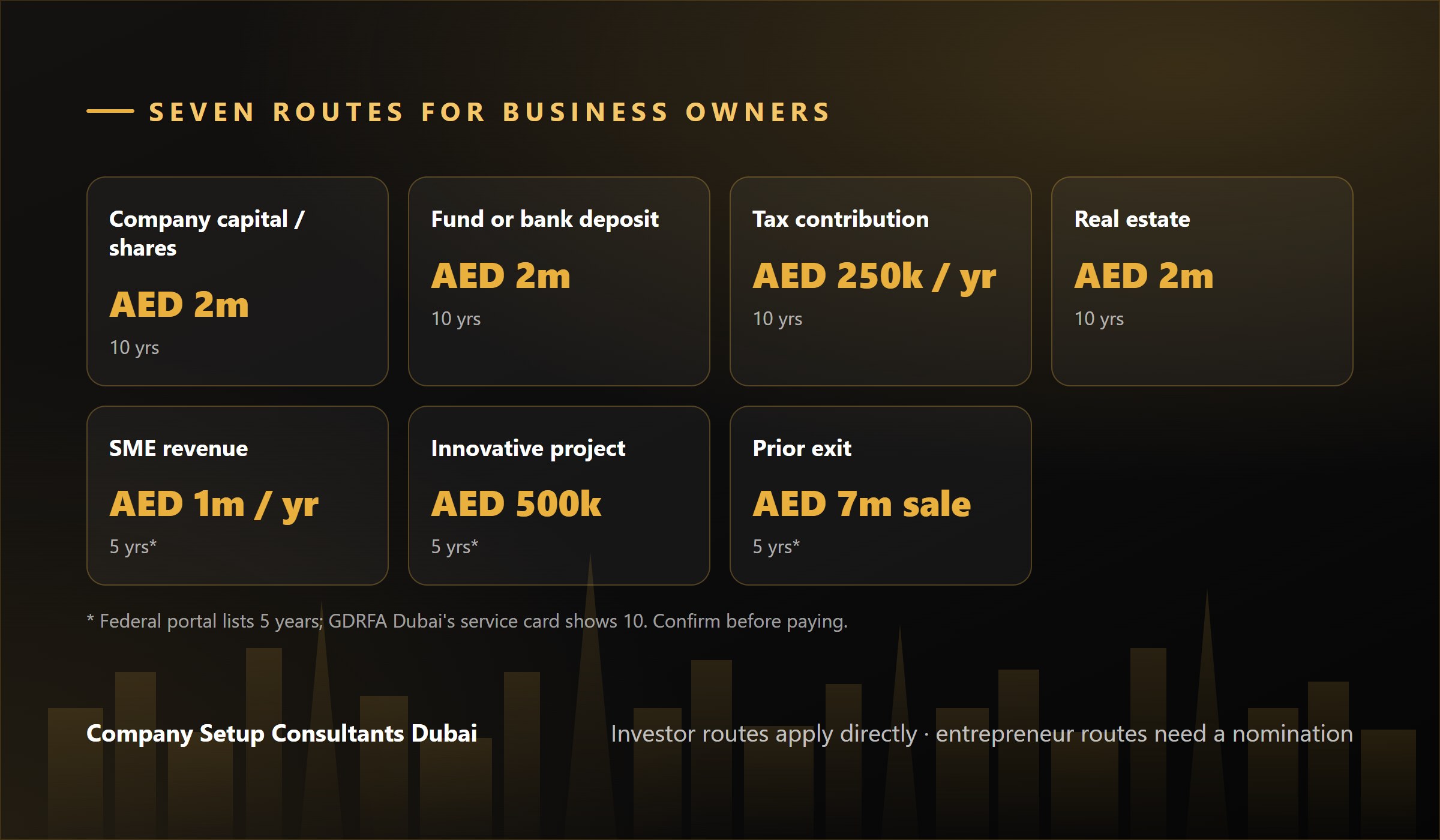
One practical note on that validity column. The federal portal describes the entrepreneur permit as five years. GDRFA Dubai's own service card for "issuing a golden residence permit (entrepreneurs)" says ten. Competitor guides quietly pick one. Ask the authority you're applying through which term you'll actually receive before you pay, because the Emirates ID and the fee are priced by the year.
How does the company-capital route work?
You qualify if you own a UAE company with capital of at least AED 2 million, or hold shares in one or more companies worth AED 2 million or more in total. The capital must be your own, not borrowed, and it has to appear in the commercial register and audited accounts, not just the memorandum.
The most common misunderstanding: the number written on your licence isn't enough. Plenty of mainland LLCs declare AED 300,000 of capital and never deposit it. Free zone companies often have a nominal AED 50,000 or even AED 1,000. To qualify, the AED 2 million has to be paid up and demonstrable.
GDRFA Dubai lists what an investor or partner in a company must produce:
- A certified financial report from an audit firm accredited in the UAE, showing the capital and your share of it.
- A valid trade licence with the partners' annex (the schedule that names every shareholder and their percentage).
- A company bank statement, typically covering the last six months, that supports the capital figure.
- Tax registration with recent receipts or a tax certificate from the Federal Tax Authority.
- For a free zone company, a certificate from the free zone authority confirming the capital and your shares, alongside the audited financials.
Abu Dhabi's Department of Economic Development adds one more item worth knowing about even if you're applying in Dubai: an updated commercial register extract showing no legal attachments against the company or your shares. A frozen shareholding won't qualify anywhere.
Two points that get argued about. First, shares across several companies can be added together. If you hold AED 1.2 million in one LLC and AED 900,000 in another, you're over the line. Second, the "not loaned" condition is real. Capital funded by a director's loan that the company owes back to you is fine, because that is your money. Capital borrowed from a bank and injected as equity is not.
The audit is the crux of this route. If your books aren't audit-ready, nothing else moves. Our audit services team prepares exactly this report, and the earlier a company keeps proper accounting and bookkeeping, the less painful that first audit is.
How does the tax-contribution route work?
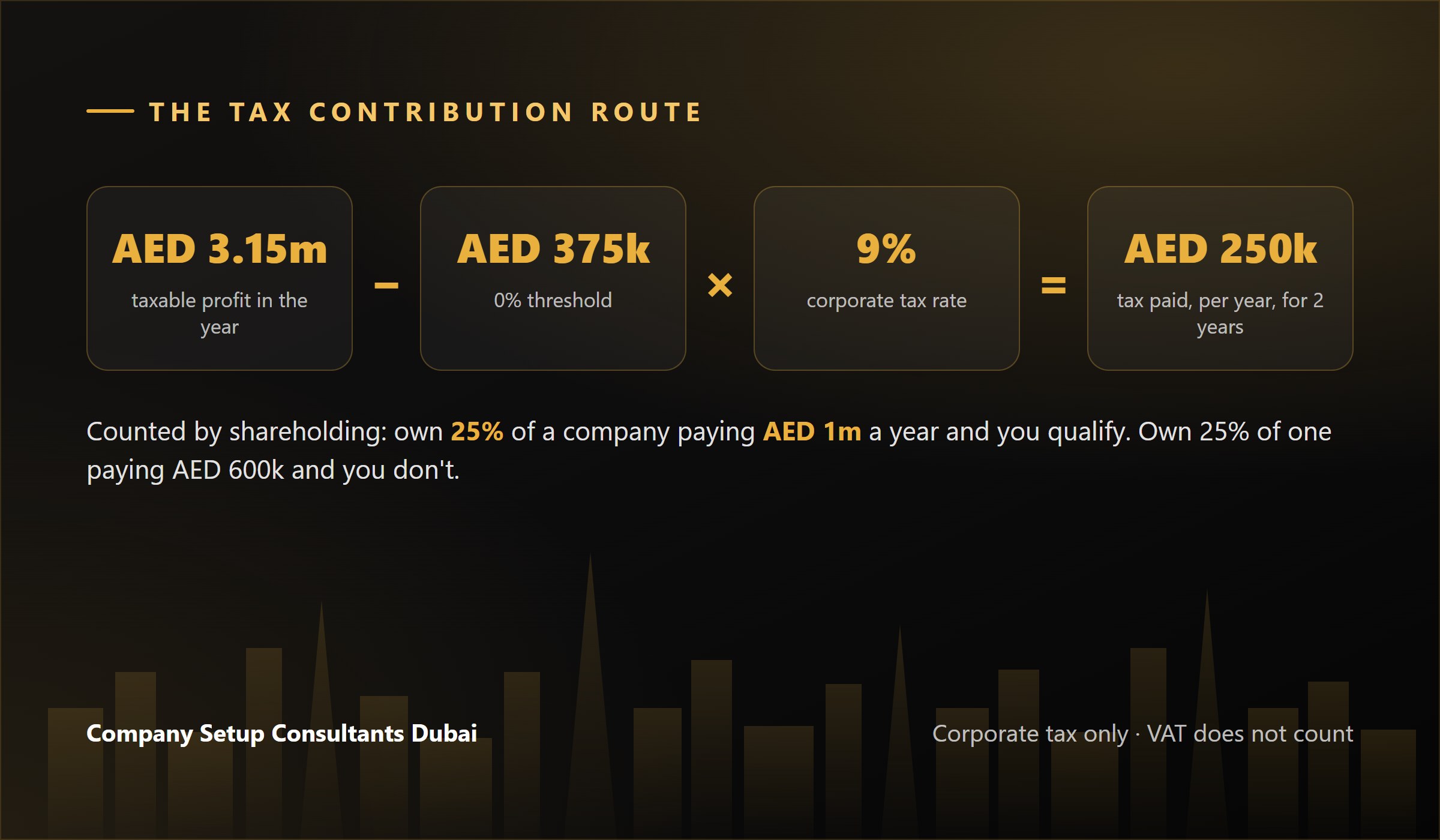
You qualify if a company you own or partner in pays at least AED 250,000 in UAE tax per year, for the two years before you apply, counted in proportion to your shareholding. Proof is a letter from the Federal Tax Authority, plus the tax returns and payment receipts for both years.
Corporate tax has only been live since June 2023, so this route is new and most guides skip it. For an established, profitable company, it's often the cleanest path because nothing has to be injected. The company just needs to keep doing what it does.
Do the maths before you get excited. UAE corporate tax is 9 per cent on taxable income above AED 375,000. To pay AED 250,000 in tax, a company needs roughly AED 2.78 million of income above the threshold, so about AED 3.15 million of taxable profit in the year. And the AED 250,000 is your share. Abu Dhabi's guidance gives the example directly: if you own 25 per cent of a company paying AED 1 million in tax a year, you're attributed AED 250,000 and you qualify. Own 25 per cent of a company paying AED 600,000 and you don't.
VAT doesn't count. The condition refers to tax paid to the state by the establishment, and in practice the FTA letter references corporate tax. A trading company that collects AED 400,000 of VAT a year isn't paying it; its customers are.
What about free zone companies enjoying the zero per cent rate as a Qualifying Free Zone Person? They pay no tax, so they can't use this route. Their owners fall back on the capital route or the entrepreneur routes. Worth thinking about before you elect into the zero per cent regime, because the visa and the tax saving pull in opposite directions.
The two-year lookback is the other catch. A company that registered for corporate tax in 2024 and filed its first return in 2025 won't have two years of payments until 2026 at the earliest. If you need residency sooner, get the standard investor visa now and switch later. Getting the company's corporate tax registration right from the start is what makes the later application clean.
How do entrepreneurs qualify?
Entrepreneurs qualify through one of three tests set by the Ministry of Economy and Tourism: owning or partnering in a registered SME with annual revenue of AED 1 million or more, being approved by an accredited business incubator or authority to set up an innovative project, or having founded a previous project sold for a total of AED 7 million or more.
The federal portal adds the AED 500,000 floor for the innovative-project test: the project has to be valued at that much or more, with a letter from the incubator confirming it, and a letter from an auditor confirming the value. Comprehensive health insurance for you and your family is a stated condition too.
The nomination step is what separates this from the investor routes. You can't file directly. In Dubai, GDRFA's entrepreneur service lists a nomination letter from the Dubai Future Authority as the required document, and its terms say plainly that nomination doesn't guarantee approval. Federally, ICP's nomination request goes through the Ministry or an approved incubator such as Hub71 in Abu Dhabi, in5 or Area 2071 in Dubai, or Sheraa in Sharjah.
The AED 1 million revenue test is the one most real businesses use. Notice it's revenue, not profit, and not capital. A consultancy billing AED 90,000 a month clears it without a dirham of paid-up capital. The catch is the word "accredited": the SME has to be in a sector the Ministry or the local authority recognises, and you'll need audited accounts to prove the revenue. Restaurants and general trading rarely get through as "pioneering". Software, healthcare, education, clean energy, logistics tech and advanced manufacturing do.
If you're building a company specifically with this in mind, structure matters. A company structure with clear shareholding and a licence activity that maps to a priority sector will get a nomination far faster than a general trading LLC.
Does the property route make sense for a business owner?
The property route requires AED 2 million or more of real estate, based on purchase value, whether completed or off-plan, mortgaged or paid in full. Since January 2024 there's no minimum paid amount; a mortgaged property needs a no-objection letter from the bank stating what's paid and what's outstanding.
If you already own a home worth AED 2 million, the property route is simply the fastest. The Dubai Land Department runs it end to end, requires you to be physically present in the UAE, and publishes a 7 to 10 business day processing time. No audit. No FTA letter. No nomination.
The DLD publishes a complete fee for the ten-year permit, which is rare. Medical examination AED 700, ten-year Emirates ID AED 1,153, residency permit AED 2,856.75, DLD fees AED 4,020, administrative fees AED 1,155. Total AED 9,884.75, with each family member at AED 5,774.50.
Two rules to check before you buy. The property must be in the investor's name, and joint ownership with a business partner splits the value. And you can't sell it during the visa term: GDRFA's conditions say the investment can't be disposed of during the ten years. That's true of the fund deposit route too. A Golden Visa freezes AED 2 million, whichever route you pick.
What conditions apply to everyone?
Every applicant needs a passport valid for at least six months, comprehensive UAE health insurance, a clean record, and a medical fitness certificate. ICP requires the residence application itself to be filed from inside the UAE, and the capital or asset has to be legally owned, documented, and not borrowed.
Age isn't a barrier and neither is nationality. You don't need Arabic, a degree or a salary. And unlike the standard investor visa there's no quota: office size and visa allocation don't matter, because the visa isn't drawn against the company at all. Health insurance gets skipped most often; get a policy that covers the family too, because their applications need it.
What documents do you need?
All routes need a passport copy, a photo, health insurance, your current Emirates ID and residence permit if you hold one, and proof of address. On top of that, each route needs its own eligibility evidence: audited financials and licence for the capital route, an FTA letter for the tax route, a nomination for entrepreneurs, or a title deed for property.
The complete pack, by route:
- Everyone: passport (six months' validity), passport-size photo on a white background, valid health insurance, current visa and Emirates ID if applicable, Ejari or tenancy contract as proof of residence in the emirate.
- Company capital or shares: trade licence with partners' annex, commercial register extract showing capital and shareholding, audited financial statements from a UAE-accredited firm, company bank statements, corporate tax registration certificate, free zone capital certificate where relevant.
- Tax contribution: trade licence with partners' annex, FTA letter confirming the establishment's tax contributions, tax returns for the two prior years, payment receipts.
- Entrepreneur: nomination letter (Dubai Future Authority in Dubai; the Ministry or an approved incubator elsewhere), business plan, licence, audited revenue or a valuation letter, proof of a previous sale where relied on.
- Property: title deed or e-certificate of title, DLD valuation certificate, bank no-objection letter if mortgaged.
- Family: attested marriage and birth certificates, family members' passports, photos and insurance.
Attestation is where family applications stall. A marriage certificate issued abroad needs the UAE embassy stamp in the issuing country, then the Ministry of Foreign Affairs here, then a legal Arabic translation. Budget two to four weeks for that alone.
How do you apply, step by step?
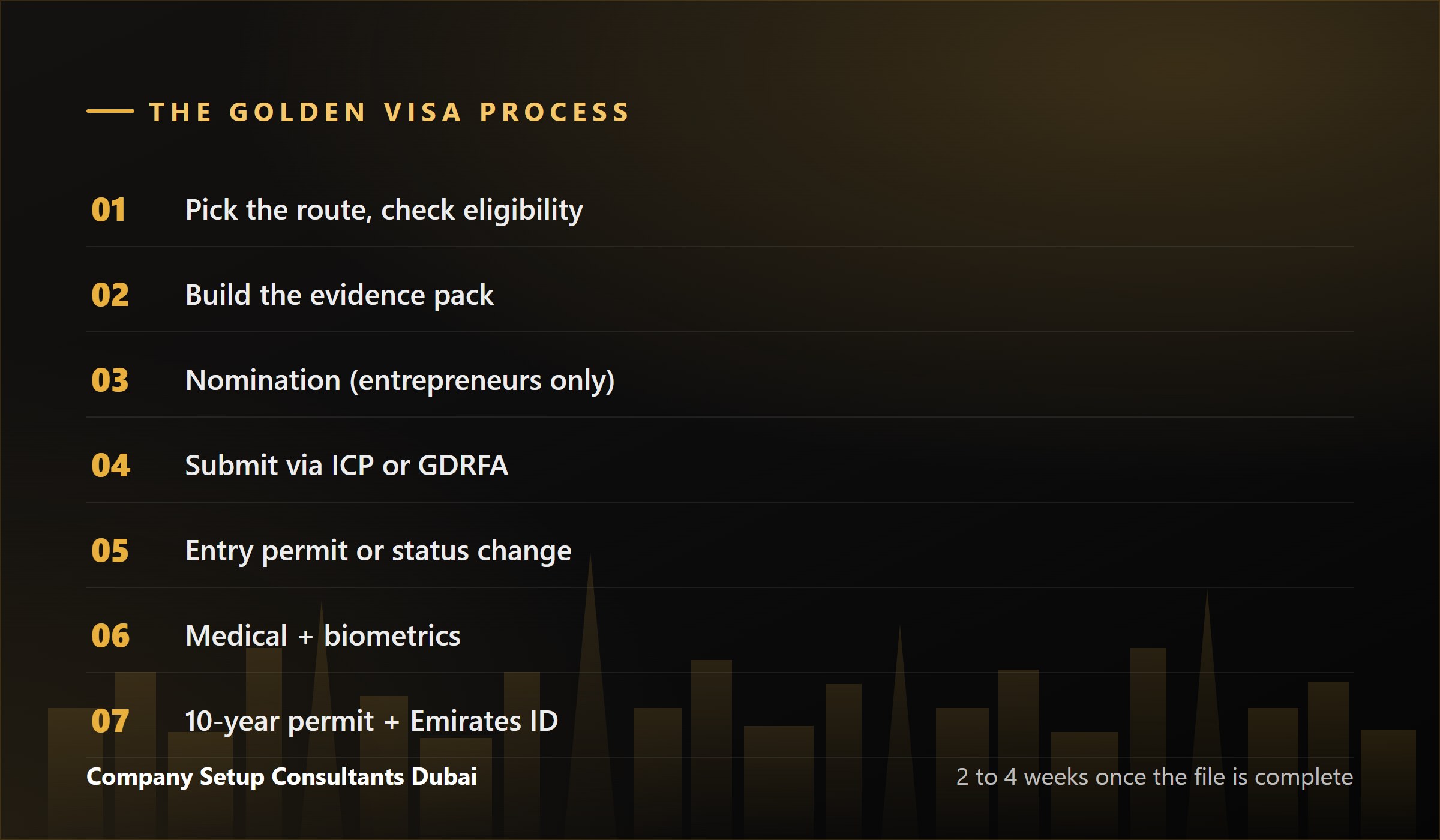
Confirm your route, gather the eligibility evidence, submit through ICP Smart Services (or GDRFA Dubai) for approval or nomination, receive the entry permit or change status in-country, complete the medical and biometrics, then collect the ten-year residence permit and Emirates ID. Investor routes take about two to four weeks; entrepreneur routes longer.
- Pick the route and check eligibility. ICP's Golden Services dashboard has an eligibility check that returns a preliminary answer before you spend anything. Choose one route; you can't blend AED 1 million of capital with AED 1 million of property.
- Build the evidence pack. For the capital and tax routes this is the slow part: the audit, the FTA letter, the bank statements. Do this before touching the portal, because the approval clock only starts on a complete file.
- Get the nomination, if your route needs one. Entrepreneurs apply to the Dubai Future Authority, the Ministry of Economy and Tourism or an approved incubator. Investors skip this step and apply directly.
- Submit the application. Log in with UAE Pass to ICP Smart Services or GDRFA Dubai's portal, choose the golden residence service for your category, upload the documents and pay. In Dubai you can also file at an Amer centre. GDRFA quotes five working days for the investor and entrepreneur services; ICP quotes two days for the residence issuance itself.
- Entry permit or status change. If you're abroad, a multiple-entry permit is issued so you can come in and complete the process. If you're already resident, your existing visa is cancelled and status is adjusted in-country. ICP's One Touch service bundles the nomination, entry permit, status change, residence and Emirates ID into one flow.
- Medical fitness test and biometrics. A blood test and chest X-ray at an approved centre, then fingerprints and photo for the Emirates ID. Same as any residence visa.
- Residence permit and ten-year Emirates ID. The permit is electronic. Your Emirates ID is the physical proof, and it's issued for the full ten years.
If you're on a two-year investor visa, the switch cancels it, and dependants' visas hang off yours. Family applications are filed after your permit issues, not with it, so plan the overlap.
How much does the UAE Golden Visa cost?
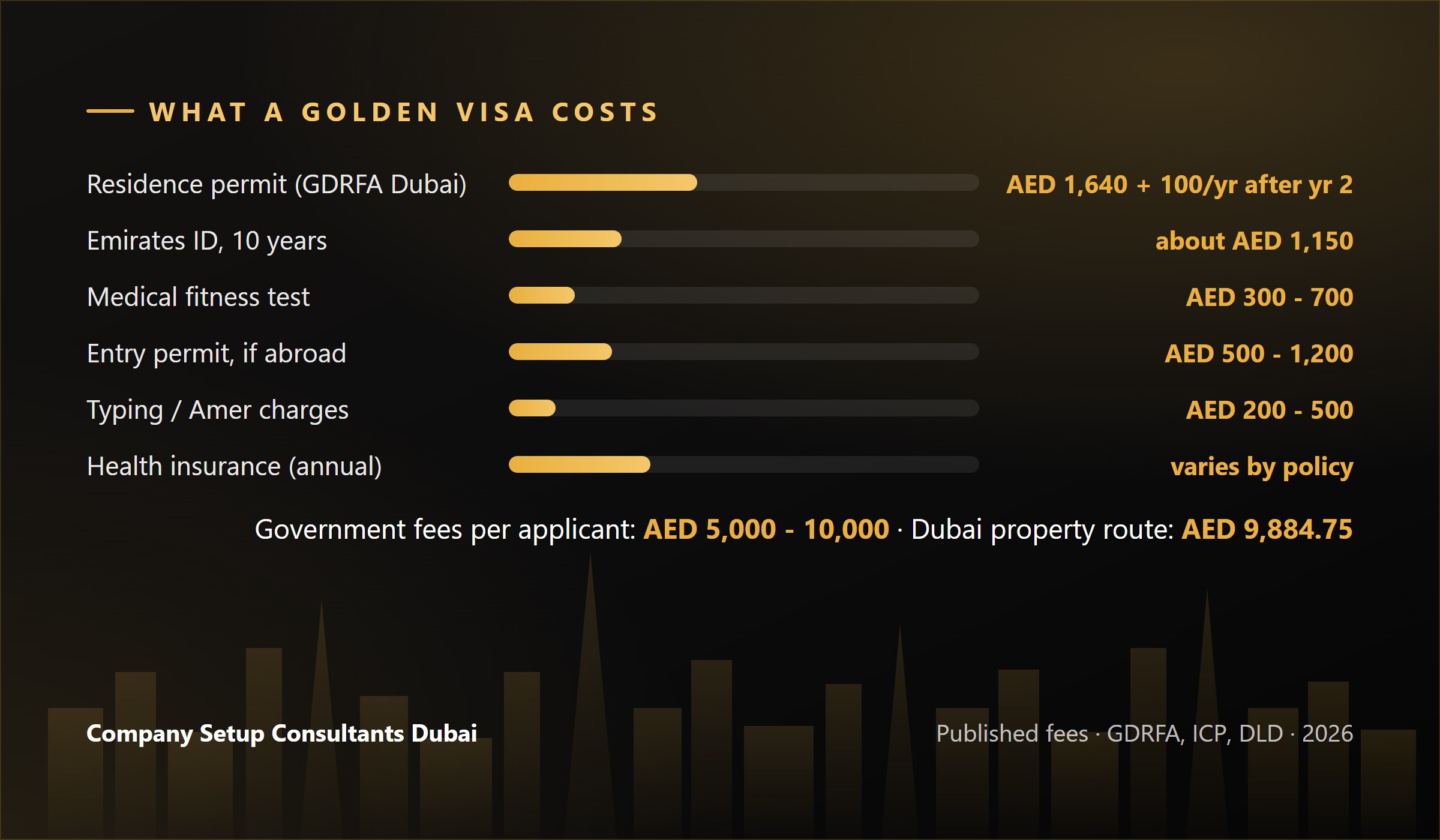
Government fees for a ten-year Golden Visa come to roughly AED 5,000 to 10,000 per applicant, depending on the emirate and route. GDRFA Dubai's permit fee is AED 1,640 before the per-year uplift, the ten-year Emirates ID is about AED 1,150, the medical test AED 300 to 700, and health insurance is on top.
The honest answer is that no single official all-in figure exists except for Dubai's property route. Here's what the authorities publish, and what you should budget:
| Item | Published fee (AED) | Source |
|---|---|---|
| Residence permit issuance (Dubai) | 1,100 + 10 knowledge + 10 innovation + 500 in-country + 20 delivery = 1,640, plus 100 per year beyond two years | GDRFA Dubai service card |
| Residence visa issuance (federal, other emirates) | 100 application + 47 issuance + 100 smart services | ICP service card |
| Emirates ID, 10 years | About 1,150 | DLD lists 1,153 |
| Medical fitness test | 300 to 700 depending on speed | DLD lists 700 |
| Entry permit, if applying from abroad | Around 500 to 1,200 | ICP / GDRFA |
| Typing centre / Amer service charges | 200 to 500 | Market rate |
| Dubai property route, complete package | 9,884.75 | Dubai Land Department |
| Each family member (Dubai property route) | 5,774.50 | Dubai Land Department |
The real numbers sit outside the fee table. The capital route needs an audit, which for a small company runs AED 5,000 to 15,000. The tax route needs AED 250,000 a year of tax, which is not a fee but is money leaving the company. The property route has the 4 per cent DLD transfer fee on the purchase, AED 80,000 on an AED 2 million flat. And if you're using a consultant, add their fee. Ours is quoted per case, not hidden in a "package".
Compared with five investor visa renewals over the same ten years, at AED 4,700 to 7,000 each, the government cost of a Golden Visa is roughly a wash. You're paying for the freedom, not saving on fees.
How long does it take?
Once a complete file is submitted, GDRFA Dubai quotes five working days for investor and entrepreneur permits and the DLD quotes 7 to 10 business days for the property route. End to end, including medical and Emirates ID, budget two to four weeks. Building the evidence pack is what adds months.
A founder with two years of audited accounts, a current FTA certificate and a clean commercial register can be done in a month. A founder who has to commission the first audit, register for corporate tax and untangle a shareholding will take three to six months, and none of that time is the government's.
Entrepreneur nominations are the least predictable stage. Incubators review to their own calendar, and that's where the "30 to 90 days" figures you'll see elsewhere come from.
Can you sponsor family and staff?
Yes. Golden Visa holders can sponsor a spouse, children of any age, and parents, each for a term matching the main permit, plus an unlimited number of domestic workers. If the holder dies, family members keep their residency until the permit expires.
The "children of any age" point is the one that changes family planning. Under the two-year visa, a son has to leave your sponsorship at 25 unless he's studying. Under the Golden Visa, he stays. Daughters were always covered until marriage; now the distinction has gone.
Each dependant is a separate application with its own medical (for adults), Emirates ID and fees; the DLD's published rate is AED 5,774.50 per family member. Income proof isn't a stated condition the way it is for the standard visa, but health insurance applies to each person.
Abu Dhabi's version goes one step further for company owners: it lets a Golden Visa investor sponsor one advisor and one executive director alongside family. If your finance director is the person who actually runs the company while you travel, that's worth knowing.
Should you get an investor visa first and upgrade later?
Usually, yes. A two-year investor visa issues within weeks of the licence and needs no minimum investment, so you can live here while the company builds the audited capital, tax history or revenue a Golden Visa needs. Only founders who already hold AED 2 million in property or a deposit should go straight to gold.
Think of it as two tickets. The investor visa is the entry ticket that comes with any properly set up company, mainland or free zone. The Golden Visa is the upgrade you qualify for once the company has substance. We rarely advise a new founder to inject AED 2 million of capital on day one purely to skip the first ticket; that money usually works harder as working capital, and the tax route may get you there anyway once the company is profitable.
The sequencing that tends to work:
- Year 0: set up the company, get the investor visa, open the corporate bank account, register for corporate tax.
- Year 1: keep audited accounts from the first day. File the first corporate tax return.
- Year 2: renew the investor visa once and file the second return. If your attributable tax crosses AED 250,000, apply. If revenue is over AED 1 million in a priority sector, seek a nomination.
- Any point: if you buy a home worth AED 2 million, switch on the property route immediately.
Where you set up affects the paperwork more than the eligibility. A Dubai mainland LLC produces a commercial register extract from the Department of Economy and Tourism that immigration recognises instantly. A Dubai free zone company needs the extra capital certificate from the zone. Neither is a problem, but the free zone one takes a week longer.
What happens to your company obligations once you hold a Golden Visa?
Nothing changes for the company. The trade licence still renews annually, the establishment card stays valid, corporate tax and VAT filings continue, and staff visas still need the company's quota. The Golden Visa only changes your personal residency; it doesn't relieve the company of a single filing.
Three things founders get wrong after the upgrade:
- Letting the licence lapse. Your residency no longer depends on it, but the bank account, staff visas and FTA registration do. On the capital and tax routes the company is also the asset that qualified you, and GDRFA reserves the right to check that it still does.
- Selling the qualifying asset. The deposit, the shares or the property that got you the visa can't be disposed of during the ten years without putting the visa at risk. Selling the company is possible, but plan the visa consequence first.
- Working elsewhere without a permit. A Golden Visa lets you run your own company without a separate work permit. Taking a salaried job with another employer still needs a Ministry of Human Resources work permit issued by that employer, even though you're self-sponsored.
Renewal at year ten is a fresh check of the same conditions, not a rubber stamp. Keep the audit trail alive throughout.
What gets Golden Visa applications refused or delayed?
The usual causes are capital that exists on the licence but not in the bank, unaudited or non-accredited financial reports, a tax route with only one year of payments, unattested family documents, applying in the wrong category, and letting the medical or entry permit expire before the next step. None of these are about the authority; they're about the file.
A few we see repeatedly:
- Declared versus paid-up capital. The memorandum says AED 2 million; the bank statement says AED 140,000. Rejected. Inject and document before applying.
- The wrong auditor. A report from a firm not on the UAE's accredited list is treated as no report.
- Loaned capital. A bank facility drawn down and parked as share capital is visible in the statements and fails the "not loaned" test.
- Mixed shareholding. Applying on AED 2 million of company capital when you own 60 per cent of it. Your share is AED 1.2 million. Either top up or combine with another holding.
A refusal isn't permanent. Fix the defect and re-file; the fees for that step are paid again, which is annoying, not fatal. And the standard investor visa is still there as a fallback while you build the case. Talk to us through the contact page if you'd like the file checked before it goes in.
Frequently Asked Questions
Can I get a UAE Golden Visa just by opening a company?
No. Opening a company gets you a two-year investor visa. A Golden Visa needs either AED 2 million of paid-up capital or shares, AED 250,000 of annual tax attributable to you for two years, an approved entrepreneur nomination, or AED 2 million in property.
Is the Golden Visa 5 years or 10 years for business owners?
Investor routes (capital, deposit, tax, property) are ten years. The federal portal lists entrepreneur routes at five years, while GDRFA Dubai's entrepreneur service page shows ten. Confirm the term with the issuing authority before paying.
Does free zone company capital count towards the AED 2 million?
Yes, if it's genuinely paid up. GDRFA asks free zone investors for a certificate from the free zone authority confirming the capital and your shares, plus audited financial statements. Nominal capital on the licence alone doesn't qualify.
Does VAT count towards the AED 250,000 tax requirement?
No. The tax route is evidenced by a Federal Tax Authority letter confirming the establishment's tax contributions, and in practice that means corporate tax. VAT is collected from customers, not paid by the company, so it isn't counted.
Can I combine shares in two companies to reach AED 2 million?
Yes. The condition is shareholding in one or more existing companies with a total value of AED 2 million or more. Each company needs its own licence, register extract and audited accounts in the file.
How much does a Golden Visa cost in Dubai?
Government fees run roughly AED 5,000 to 10,000 per person depending on the route. The Dubai Land Department publishes AED 9,884.75 for the property route, including medical, ten-year Emirates ID and residency fees, with AED 5,774.50 per family member.
Do I still need to renew my trade licence with a Golden Visa?
Yes. The Golden Visa changes only your personal sponsorship. The company's licence, establishment card, corporate tax and VAT filings, and staff visas continue exactly as before. On the capital and tax routes the company is also the asset that qualified you.
Can I work for another company on a Golden Visa?
You can run your own company without a separate permit. Taking employment with another company still requires that employer to issue a Ministry of Human Resources work permit, even though your residency is self-sponsored.


