

Most people setting up in the UAE get stuck on the same fork before they've spent a dirham. Mainland, free zone, or offshore? Pick wrong and you either overpay for freedom you don't need, or save money now and hit a wall the first time you try to sell to a customer down the road. The mainland vs free zone vs offshore decision quietly shapes your costs, your visas, your tax, and where you're even allowed to do business.
It's a genuinely confusing choice, partly because there are so many options underneath it. The UAE runs more than 40 free zones alongside the Dubai mainland and a handful of offshore registries (UAE Ministry of Economy), each with its own rules and price tag. No wonder founders freeze.
This guide cuts through it. What each structure actually is, how they compare on the things that matter, what they cost, who each one suits, and whether you can switch later when the business grows. By the end you'll know which column you belong in.
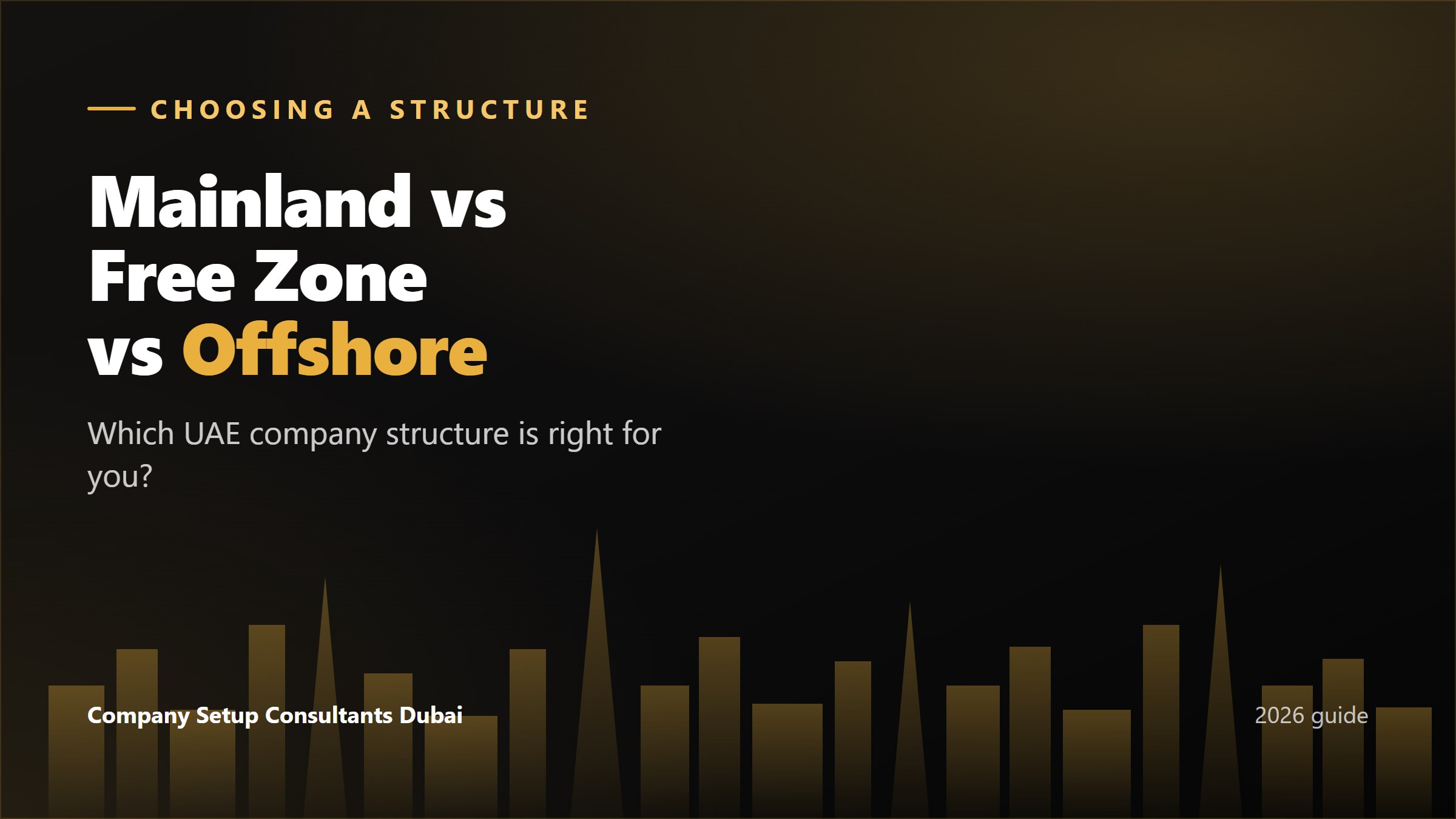
What's the difference between mainland, free zone, and offshore?
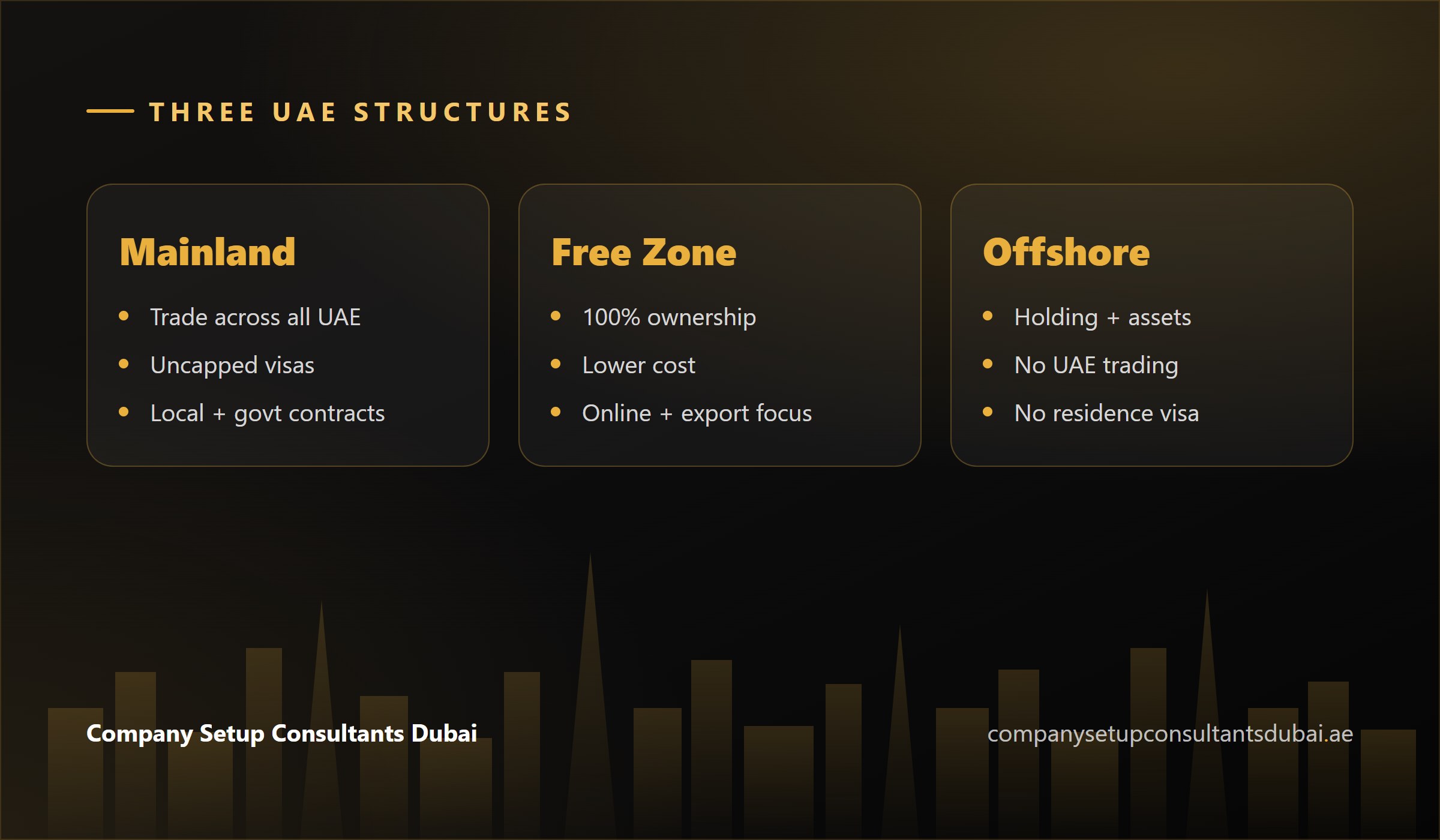
A mainland company can trade anywhere in the UAE and sponsor unlimited visas. A free zone company gets 100% ownership and lower costs but can't sell directly on the mainland without a distributor. An offshore company is for holding assets and international business only, with no UAE trading and no visas.
That's the whole thing in three sentences, but the detail is where the money hides. Here's how the three stack up side by side before we go deeper on each.
| Factor | Mainland | Free zone | Offshore |
|---|---|---|---|
| Regulated by | DET (Dept of Economy) | The free zone authority | Offshore registry (JAFZA, RAK ICC) |
| Foreign ownership | Up to 100% | 100% | 100% |
| Trade inside the UAE | Yes, anywhere | Via a distributor or dual licence | No |
| Residence visas | Yes, uncapped (office-linked) | Yes, 1–6 typical (package) | None |
| Office | Leased office + Ejari | Flexi-desk accepted | None |
| Corporate tax | 9% above AED 375k | 0% on qualifying income (QFZP) | Usually outside UAE tax |
| Indicative first-year cost | AED 20,000–50,000+ | AED 5,750–35,000 | AED 8,000–25,000 |
| Best for | Local trade, retail, contracts | Online, export, consulting | Holding, assets, structuring |
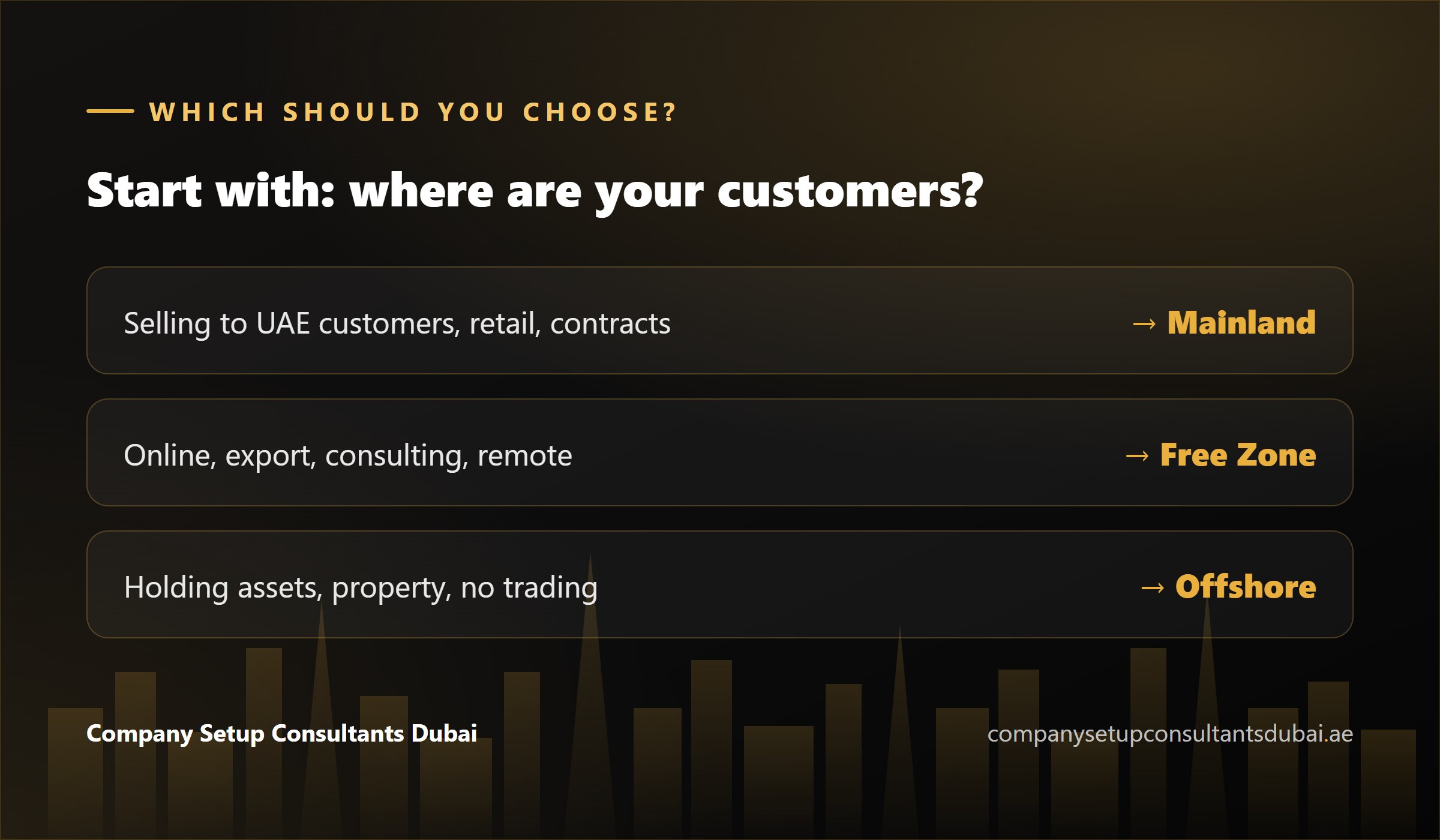
Read that table twice and most of the decision makes itself. If your customers are in the UAE, you're looking at mainland. If they're online or abroad, free zone. If you're holding assets rather than trading, offshore. The rest of this guide is the fine print behind each. For the full setup process behind any of them, see our guide on how to start a business in Dubai.
What is a mainland company, and who is it for?
A mainland company is licensed by Dubai's Department of Economy and Tourism and can trade anywhere in the UAE, take government contracts, and sponsor unlimited visas. Since 2021 most activities allow 100% foreign ownership. It suits retail, restaurants, contracting, clinics and anyone whose customers are physically here.
The mainland used to scare foreigners off because of the old 51% local sponsor rule. That's gone for most activities since the 2021 Commercial Companies Law reform, so a mainland company is now a genuine option for full ownership, not a compromise.
What you're really buying is reach. A mainland company can open a shop in any emirate, bid for government work, and sell straight to UAE customers with no middleman. The trade-off is cost and admin: you need a real leased office with an Ejari tenancy contract, and you pay a market fee of 5% of your rent each year.
The upside beyond trade rights is scale. Because visas are tied to office size rather than a fixed quota, a mainland company can grow its team without hitting a wall, just lease more space. The downside is that it's the priciest to run and the most paperwork-heavy of the three. Retailers, restaurants, contractors, clinics and service firms with local clients almost always land here. Our Dubai mainland setup page covers the activity list and approvals.
What is a free zone company, and who is it for?
A free zone company is registered inside one of the UAE's 40-plus economic zones, with 100% ownership, lower costs, and packages that bundle the licence, a desk and visas. It trades freely internationally and within its zone, but not directly on the mainland. It suits online, export, consulting and holding businesses.
Free zones are self-governing economic areas, each with its own registrar and usually its own industry focus, DMCC for commodities, Dubai Internet City for tech, Dubai Media City for creative. They're the popular starting point for first-timers because a single package can bundle the licence, a flexi-desk and a visa or two into one predictable, lower fee.
The one real limit is where you can sell. A free zone company can't invoice UAE mainland customers directly without appointing a mainland distributor or adding a dual licence. For e-commerce, consultancy, freelancing and export, that limit rarely bites, which is exactly why those businesses cluster in free zones.
The other thing to watch is the visa quota. Unlike the mainland's office-linked, uncapped model, a free zone gives you a fixed number of visas per package, so a fast-growing team can outgrow its allowance and need an upgrade. For a solo founder or a small remote team, that's a non-issue. Weigh cost, sector fit and quota together, not just the headline price. Compare them on our Dubai free zones overview.
What is an offshore company, and who is it for?
An offshore company, like a JAFZA or RAK ICC entity, exists for holding assets, owning property, and international structuring. It can't trade inside the UAE, rent local office space, or sponsor residence visas. It suits holding companies, asset protection and international trade, not day-to-day operations.
Offshore is the one people misuse most. It's cheap and private, so it looks attractive, but you get less because it does less. There's no visa, no physical presence, and no selling into the UAE market. If you need to live here or hire staff, offshore is simply the wrong tool.
Where it shines is as a holding layer: owning shares in other companies, holding real estate, or structuring international trade cleanly. Plenty of business owners run an offshore holding entity above their operating free zone or mainland company, keeping the assets in one place and the trading in another.
It's also the most private and the lowest-maintenance of the three, with no annual office to renew and minimal local reporting when there's no UAE income. Just don't expect it to do anything operational. The moment you need to invoice a UAE client, hire someone here, or get a residence visa, offshore stops being the answer and you're back to mainland or free zone. See where it fits on our offshore company formation page.
How do the three compare on cost?
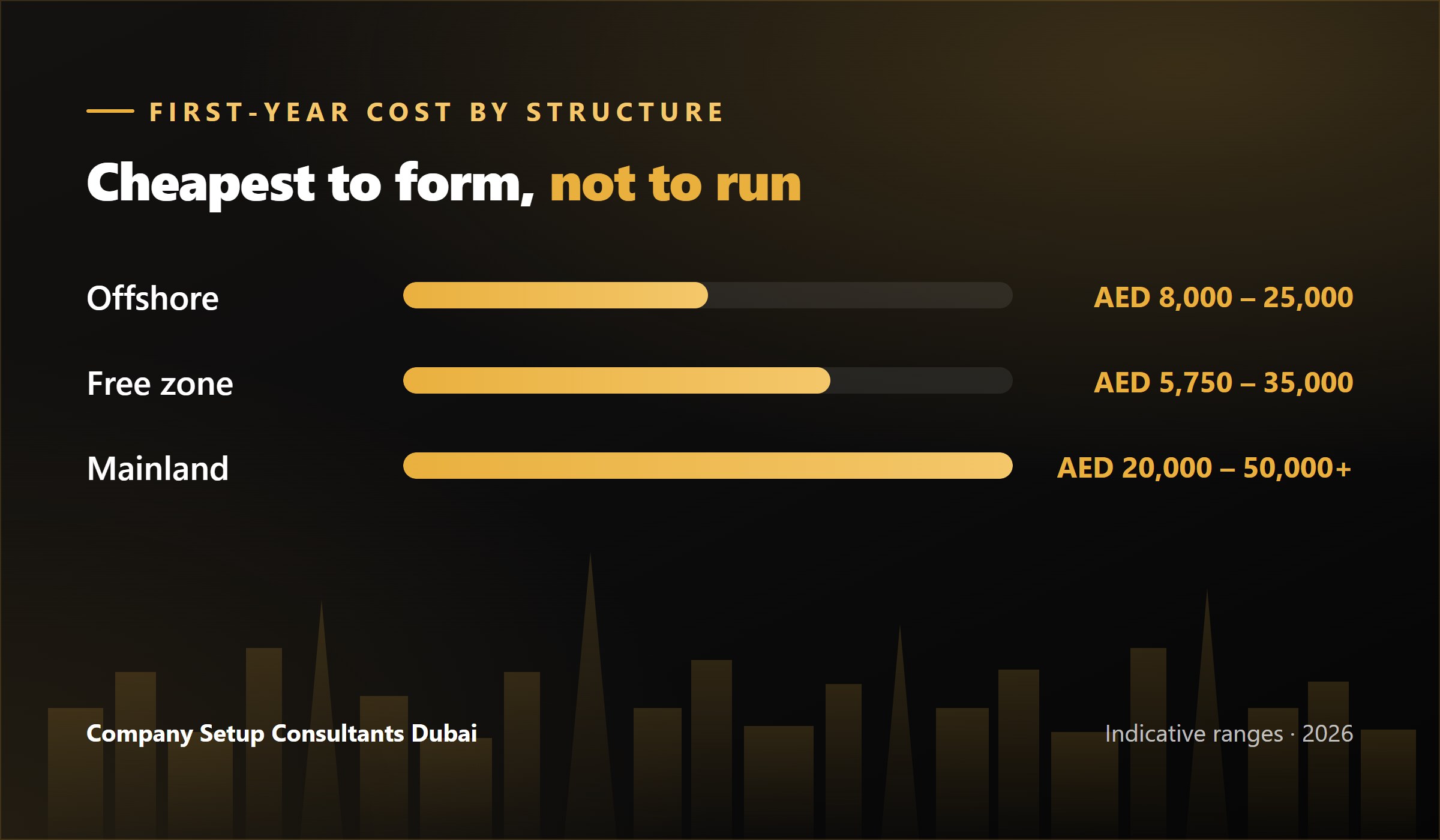
Offshore is cheapest to form at roughly AED 8,000 to AED 25,000 because it needs no office or visas. Free zones run about AED 5,750 to AED 35,000, bundling desk and visas. Mainland costs most at AED 20,000 to AED 50,000+ because of the leased office, market fee and uncapped visas.
Cost is where a lot of people over-index on the sticker price and ignore what they're actually getting. Offshore looks cheapest, but it can't earn you a dirham inside the UAE. Here's the rough shape:
| Structure | First-year cost (AED) | Why |
|---|---|---|
| Offshore | 8,000 – 25,000 | No office, no visas, holding only |
| Free zone | 5,750 – 35,000 | Bundled desk + visas; varies by zone |
| Mainland | 20,000 – 50,000+ | Leased office, 5% market fee, uncapped visas |
Notice the free zone range is the widest, from a cheap northern-emirates package to a premium Dubai zone like DMCC. The cheapest option that can't do what you need isn't cheap, it's wasted. For a full line-by-line breakdown, we've got a dedicated guide on the cost of business setup in Dubai.
How do they compare on visas?
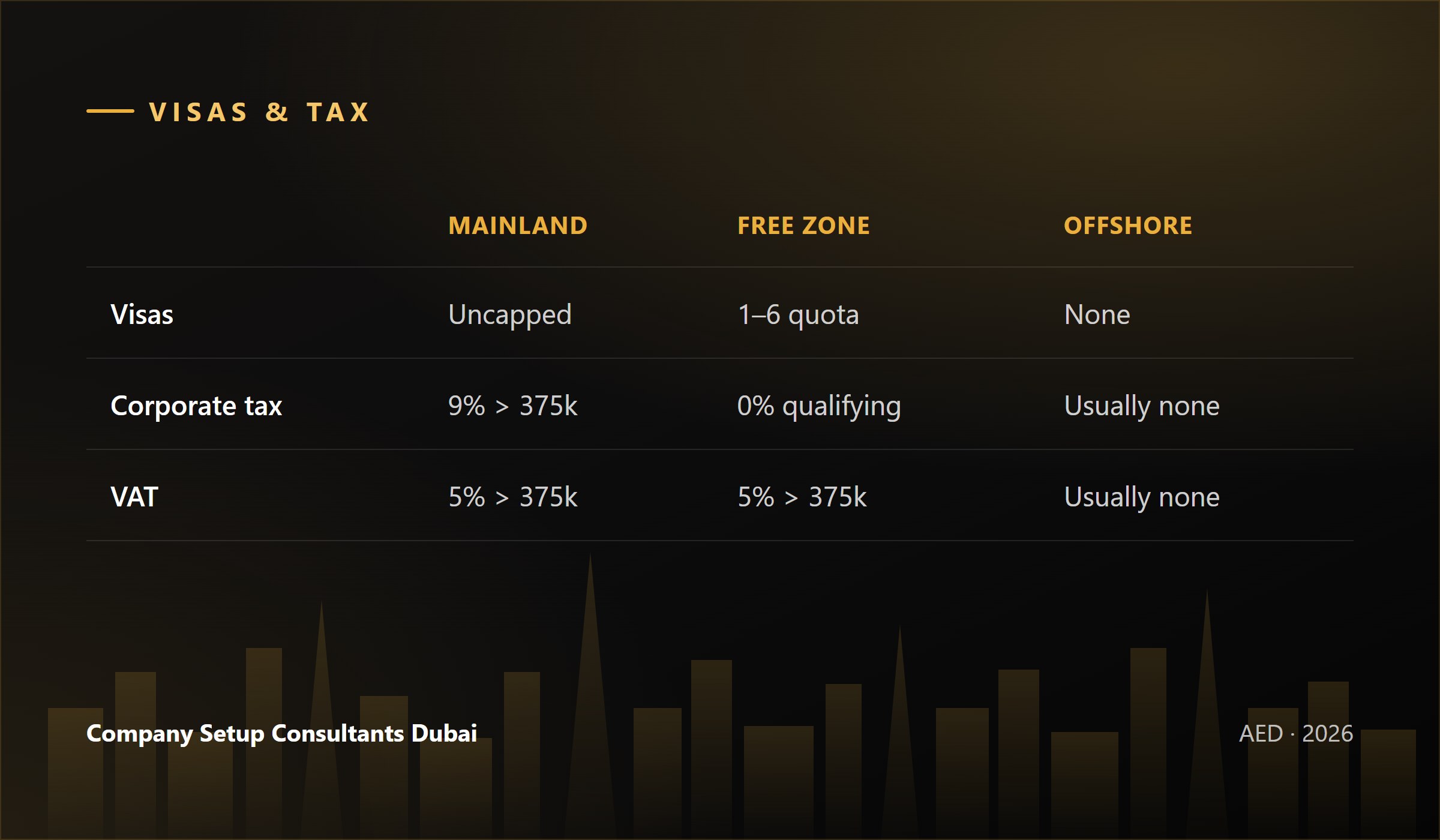
Mainland companies sponsor unlimited residence visas, tied roughly to office size (about one per 80 square feet). Free zone companies get a fixed quota, usually one to six depending on the package and desk. Offshore companies sponsor no visas at all, because there's no UAE residence attached.
Visas matter more than people expect, because they decide who can actually live in the UAE off the back of the company. If you're planning to relocate, hire a team, or sponsor family, this line can override the cost line entirely.
- Mainland: no fixed cap. More office space unlocks more visas, so a growing team just needs a bigger lease.
- Free zone: a set quota baked into your package. A flexi-desk might allow one to three; a small office more. Exceeding it means upgrading.
- Offshore: zero. If you need residence, offshore can't give it to you, full stop.
So a family relocating and hiring locally leans mainland or a larger free zone package. A solo founder serving clients abroad is fine on a lean free zone quota of one.
How do they compare on tax?
All UAE companies face 9% corporate tax on profits above AED 375,000 and 5% VAT above AED 375,000 turnover. Qualifying free zone companies can keep 0% corporate tax on qualifying income. Offshore entities with no UAE-source income usually sit outside both. There's no personal income tax anywhere.
The "tax-free Dubai" line stopped being fully true in June 2023, when the UAE introduced federal corporate tax. How it lands depends on your structure:
- Mainland: 9% on profit above AED 375,000, 0% below. Straightforward, and it must register with the Federal Tax Authority regardless. More on our corporate tax registration page.
- Free zone: a Qualifying Free Zone Person can keep 0% on qualifying income, but the conditions are strict, adequate substance, qualifying activities, proper documentation. Get one wrong and you fall to 9%.
- Offshore: with no UAE trade or income, it generally falls outside UAE corporate tax and VAT, which is part of its appeal for holding.
VAT at 5% applies to any structure once taxable turnover crosses AED 375,000, covered under VAT registration. Whatever you pick, clean books are now non-negotiable.
How long does each one take to set up?
Free zones are usually fastest at three to seven working days, offshore takes three to five, and mainland runs five to ten. Visas add another one to two weeks after the licence. Speed depends far more on having complete documents than on the structure you pick.
If you're in a hurry, the differences are real but small. Free zones tend to be quickest because everything, the registrar, the desk and the visa quota, sits under one roof, so there's less back-and-forth. Mainland takes a little longer because of the Ejari tenancy step and any activity approvals. Offshore is quick on paper but gives you nothing to operate with once it's done.
| Structure | Licence issued | Add for visas |
|---|---|---|
| Free zone | 3 – 7 working days | 7 – 14 days |
| Mainland | 5 – 10 working days | 7 – 14 days |
| Offshore | 3 – 5 working days | Not applicable |
The real timeline killer isn't the jurisdiction; it's a missing stamp or a name mismatch that resets the clock. A clean document pack moves fast anywhere.
Can a free zone company sell on the UAE mainland?
Not directly. A free zone company can't invoice mainland customers on its own. To sell locally it must appoint a UAE-registered distributor, open a mainland branch, or take a dual licence that adds mainland trading rights. Each adds cost but is cheaper than forming a second company.
This is the single most misunderstood limit in the whole decision, and the one that catches people who chose free zone purely on price. If your plan is to sell to shops, offices or consumers inside the UAE, a bare free zone licence won't let you do it.
The workarounds exist, though. A distributor handles local sales for a margin. A mainland branch extends your reach for extra fees. A dual licence, where the free zone and DET cooperate, lets one company hold both, which is neat if you outgrow the free zone but don't want to restart. None are free, so it's better to see the limit coming than to hit it by surprise.
Which structure should you choose?
Choose mainland if your customers are inside the UAE or you want government contracts. Choose a free zone if you sell online, export, or consult, and want lower cost with 100% ownership. Choose offshore only to hold assets or structure internationally, never to operate locally.
Rules of thumb only get you so far, so match your case to one of these:
- You sell to UAE customers (retail, restaurant, clinic, contractor, local services) → Mainland. You need to invoice locally and often want government work.
- You sell online, abroad, or as a consultant (e-commerce, agency, freelancer, export) → Free zone. Lower cost, 100% ownership, and the mainland limit rarely bites.
- You're holding assets, property or IP with no UAE trading and no need to live here → Offshore. Cheap, private, purpose-built for structuring.
- You want both local sales and low cost → start free zone and add a dual licence or distributor when local demand appears.
If you're still torn between mainland and free zone, the deciding question is almost always the same: where is the customer? Answer that honestly and the structure follows. Our business setup service maps your activity to the right one before you commit.
Which structure did three real businesses pick?
A freelance designer serving clients abroad chose a free zone for low cost and 100% ownership. A homeware retailer selling in Dubai malls chose mainland for direct local trade. A family holding UAE property chose offshore to own the assets cleanly. Each matched the structure to how they actually operate.
Ranges and rules are useful, but seeing the call made lands better. Three quick scenarios:
- The freelance designer → free zone. All her clients are overseas, she works from a laptop, and she wants to keep costs low and ownership full. A services licence in a zone like IFZA with a flexi-desk and one visa does everything she needs for well under AED 20,000.
- The homeware retailer → mainland. He sells physical goods in Dubai malls and to local interior designers, so he must invoice UAE customers directly. That rules out a bare free zone licence. A mainland commercial licence with a leased unit costs more, but it's the only structure that lets him trade where his buyers are.
- The family holding → offshore. They own two Dubai apartments and some overseas shares, with no intention of trading or living off the entity. A RAK ICC offshore company holds it all cleanly and cheaply, with no office or visa they'd never use.
Same three structures, three completely different businesses. In every case the winning question was how the business operates, not which licence looked cheapest on a billboard.
Can you switch between structures later?
There's no one-click conversion between structures. You can't flip a free zone company into a mainland one. Instead you form a new entity in the target jurisdiction and migrate the business, or add a dual licence or branch to extend reach. Plan the switch; don't assume it's instant.
This is the part most guides skip, and it matters because businesses grow. A free zone consultancy that starts landing UAE clients, or an offshore holding that decides to trade locally, both face the same reality: structures don't morph on demand.
In practice you have a few paths. Add a dual licence or a mainland branch to keep your existing company and gain local rights. Or form a fresh mainland entity and move the operating business across, keeping the old one for what it still does well. Offshore-to-operating usually means setting up a new free zone or mainland company entirely, since offshore was never built to trade. None of it is a disaster, but it's cheaper and cleaner to pick with a year or two of growth in mind than to unpick later.
What mistakes do people make when choosing?
The common mistakes are choosing free zone purely on price then needing to sell on the mainland, picking offshore expecting a visa, over-buying a premium free zone you don't need, and ignoring the corporate tax conditions. Each one costs money to undo.
A few worth naming plainly:
- Free zone for a local business. The cheapest setup is useless if you can't invoice your customers. Decide where you sell first.
- Offshore for residence. People pick offshore for the low price, then discover it gives no visa and no UAE presence.
- Overpaying for prestige. A premium zone's name doesn't help a business that just needed a cheap services licence.
- Assuming 0% tax is automatic. Free zone 0% depends on strict conditions; miss them and you're at 9% like everyone else.
There's a subtler one too: choosing for today and ignoring next year. A structure that fits a solo founder can strain a ten-person team, and a free zone that suited pure exports gets awkward the day a big UAE client calls. You don't need to predict everything, but picking with a little runway in mind saves an expensive restructure later.
Most of these trace back to choosing on price alone. The structure is a decision about how your business will actually operate, not just what it costs to open.
Frequently Asked Questions
What is the main difference between mainland and free zone?
A mainland company can trade directly anywhere in the UAE and sponsor unlimited visas, while a free zone company has lower costs and 100% ownership but can't sell directly on the mainland without a distributor or dual licence.
Is a free zone or mainland company better?
It depends on your customers. Free zone is better for online, export and consulting businesses that want lower costs. Mainland is better if you sell to UAE customers, run a shop, or want government contracts.
Can a free zone company work in Dubai mainland?
Not directly. A free zone company needs a mainland distributor, a branch, or a dual licence to sell to customers on the UAE mainland. Its own licence only covers its zone and international trade.
Which is cheapest: mainland, free zone, or offshore?
Offshore is cheapest to form at around AED 8,000 to AED 25,000, followed by free zones from AED 5,750. Mainland costs most because of the leased office, market fee and uncapped visas. But cheapest only helps if it fits your business.
Can an offshore company get a UAE residence visa?
No. Offshore companies cannot sponsor residence visas or rent local office space. If you need to live in the UAE, you need a mainland or free zone company instead.
Do free zone companies pay corporate tax?
A qualifying free zone company can keep a 0% corporate tax rate on qualifying income, but the conditions are strict. Non-qualifying income is taxed at 9%, the same as mainland companies above AED 375,000.
Can I change from a free zone to a mainland company later?
Not by conversion. You either add a dual licence or branch to your existing company, or form a new mainland entity and migrate the business. It's doable but not instant, so plan for growth early.
Which structure gives 100% foreign ownership?
All three can. Free zone and offshore have always allowed 100% ownership, and since the 2021 reform most mainland activities do too. Ownership is rarely the deciding factor anymore; trade rights and cost are.


