

Ask three business setup agents what it costs to open a company in Dubai and you'll get three different numbers, usually a suspiciously round "from AED 5,750" on a billboard, a mid-range figure over the phone, and a much bigger one once the paperwork starts. The real cost of business setup in Dubai isn't a single price. It's a stack of fees that shifts with your jurisdiction, your activity, your office, and how many visas you need.
That's also why the quotes vary so wildly. The UAE runs more than 40 free zones alongside the Dubai mainland (UAE Ministry of Economy), and each one prices its licences, desks and visa packages differently. Pick the wrong lane and you can pay double for the same business.
This breakdown lays out every line in dirhams, what's mandatory versus optional, the costs agents quietly leave off the quote, and three real worked examples so you can see what an actual business pays in year one. No billboard math.
How much does business setup in Dubai cost?
Business setup in Dubai typically costs between AED 12,500 and AED 35,000 in the first year for a simple company with one visa. A lean free zone package starts near AED 5,750, while a mainland trading company with staff and an office can run past AED 50,000.
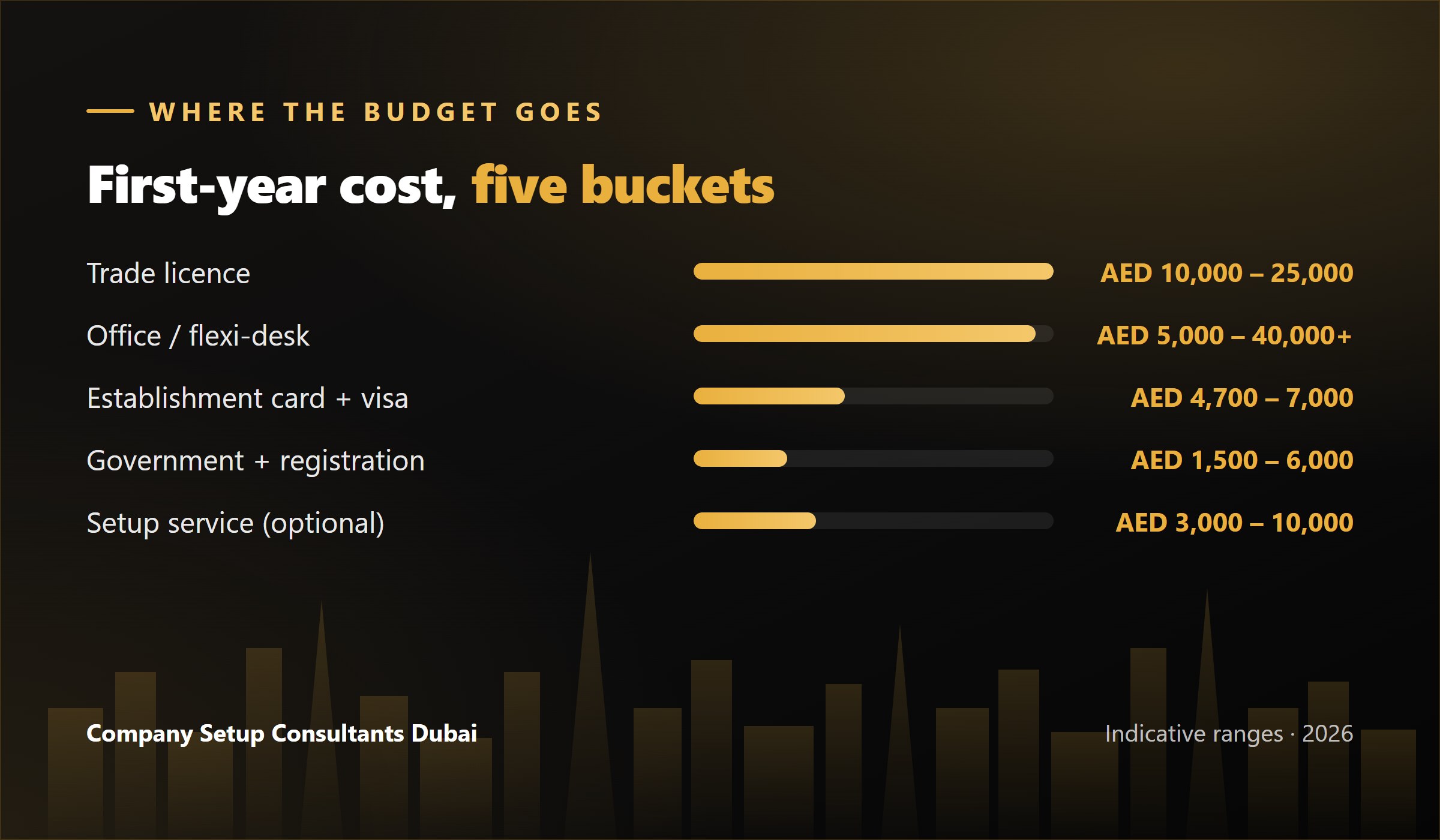
There's no honest one-line answer, so start with the shape of it. Most first-year budgets break into five buckets: the trade licence, government and registration fees, office or desk, visas, and the extras nobody quotes. Here's a quick reference before we go line by line.
| Cost bucket | Typical first-year range (AED) |
|---|---|
| Trade licence | 10,000 – 25,000 |
| Government & registration fees | 1,500 – 6,000 |
| Office or flexi-desk | 5,000 – 40,000+ |
| Establishment card + one investor visa | 4,700 – 7,000 |
| Setup service fee (optional) | 3,000 – 10,000 |
| Realistic first-year total | 12,500 – 50,000+ |
The spread is huge because a freelancer on a flexi-desk and a retailer with a shopfront are barely the same species. The rest of this guide is about finding your number inside that range. If you want the full process behind these costs, our step-by-step guide on how to start a business in Dubai walks the whole sequence.
What determines the cost of business setup in Dubai?
Five things drive the cost: your jurisdiction (mainland, free zone or offshore), your business activity and licence type, your office requirement, the number of visas you need, and whether a regulated activity triggers extra approvals. Change any one and the total moves.
Think of it as dials, not a fixed menu. Turn them and the price follows:
- Jurisdiction. Free zones bundle licence, desk and visas into one package and usually come in cheaper. Mainland costs more because you're buying the right to trade across the whole UAE.
- Activity and licence type. A professional consultancy licence is cheaper than a general trading licence, which lets you deal in almost anything.
- Office. A shared flexi-desk is a fraction of a real leased office with Ejari. This is often the single biggest swing in the budget.
- Visas. Each residence visa adds a few thousand dirhams. Your visa quota is tied to your office size or free zone package.
- Regulated approvals. Food, health, education, financial and legal activities need sign-off from bodies like Dubai Municipality, the DHA or the Central Bank, each with its own fee.
There's a fifth, quieter driver too: size. A one-person consultancy and a ten-person trading firm can hold the same licence type, but the bigger team needs more office and more visas, so its total is multiples higher. Cost scales with headcount and space far more than with the licence itself. That's why "how much does setup cost" really means "how big are you starting."
Get these decisions right before you pay anyone, and the quote stops being a mystery.
How much does a trade licence cost in Dubai?
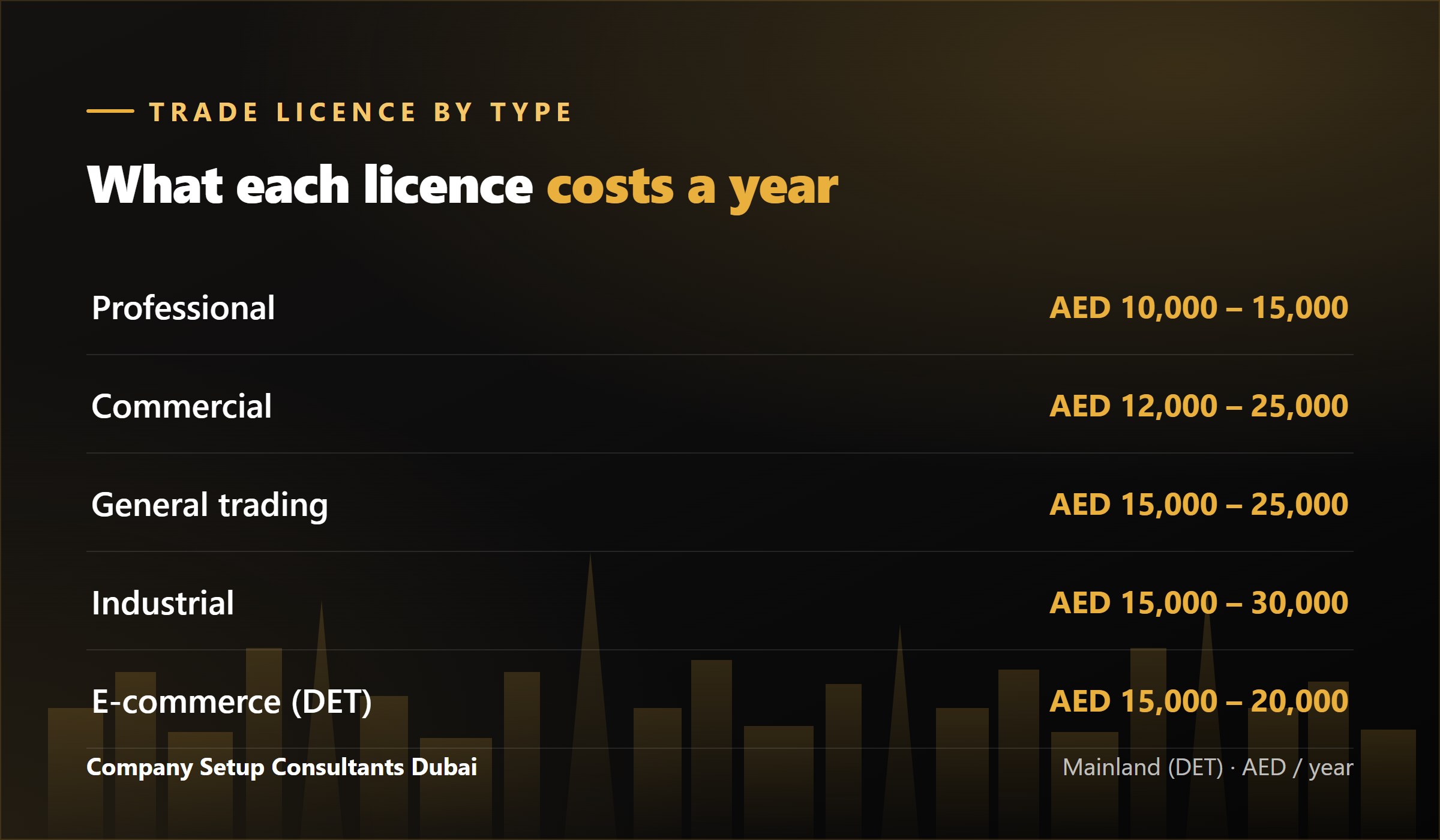
A Dubai trade licence costs roughly AED 10,000 to AED 25,000 a year on the mainland, depending on type. Professional licences sit at the lower end, commercial and general trading at the higher end, with industrial and tourism licences in between. Free zone licences start lower, near AED 5,750.
The licence is the headline number, and the type you need is set by your activity. You don't get to pick the cheapest one; you pick the one that covers what you actually do. Rough 2026 mainland (DET) ranges:
| Licence type | Best for | Cost (AED / year) |
|---|---|---|
| Professional | Consultancy, IT, marketing, services | 10,000 – 15,000 |
| Commercial | Buying and selling goods, retail | 12,000 – 25,000 |
| General trading | Trading a wide range of goods | 15,000 – 25,000 |
| Industrial | Manufacturing, assembly | 15,000 – 30,000 |
| Tourism | Travel agencies, tour operators | 12,000 – 22,000 |
| E-commerce (DET) | Online retail | 15,000 – 20,000 |
One thing the licence fee does not cover: the government registration steps, the office, or your visas. Agents love to quote the licence alone because it's the smallest scary number. Treat it as maybe a third of your real first-year cost. Our Dubai mainland setup page lists the activities each licence type unlocks.
What does the trade licence fee actually include?
The trade licence fee only covers the government's permission to run your listed activities for one year. It does not include the trade name reservation, initial approval, the MOA, your office lease, Ejari, visas, the establishment card, or a bank account. Those are all separate.
This is the single biggest source of "but the quote said AED 12,000" arguments. The licence is one line on a much longer bill. What sits outside it:
- The one-time registration steps: name reservation, initial approval, MOA notarisation.
- Your premises: a flexi-desk or a leased office with Ejari, plus the mainland market fee.
- The whole immigration stack: establishment card, visas, medical, Emirates ID.
- The bank account, its minimum balance, and from year two, your audit.
Add those up and the licence is usually a third to a half of the real first-year cost. Any quote that stops at the licence number is telling you the smallest part of the story.
What are the government and registration fees?
The government and registration fees add roughly AED 1,500 to AED 6,000 on top of the licence. They cover trade name reservation, initial approval, the Memorandum of Association, and small mandatory charges like the knowledge and innovation fees. These are mostly one-time, paid during setup.
These are the smaller line items that agents fold into a vague "government fees" figure. Individually they're modest; together they add up. The usual list:
| Item | Cost (AED) | When |
|---|---|---|
| Trade name reservation | 600 – 2,000 | One-time |
| Initial approval | 120 – 2,000 | One-time |
| Memorandum of Association (notarised) | 900 – 3,000 | One-time (LLC) |
| Knowledge + innovation fees | ~10 each, per service | Per transaction |
| Market fee (mainland) | 5% of annual rent | Annual |
The market fee catches people out. On the mainland it's 5% of your annual office rent (20% for warehouses), added to the licence each year, so a bigger office quietly raises your renewal too. Free zones don't charge it, which is one reason their all-in packages look cleaner.
How much does office space cost in Dubai?
Office cost is the widest swing in the whole budget. A free zone flexi-desk runs about AED 5,000 to AED 12,000 a year, while a real leased office on the mainland with Ejari registration starts around AED 15,000 and climbs past AED 60,000 in prime areas. Your office also sets your visa quota.
Every mainland company needs a physical address with a tenancy contract registered through Ejari, the government system that makes a lease official. Ejari registration itself is cheap, around AED 220, but the lease behind it isn't. Free zones are more forgiving: a flexi-desk (a shared workspace slot) satisfies the address requirement without a full lease, which is why online and consultancy businesses lean free zone.
There's a rough ladder of options, cheapest first. A flexi-desk or hot desk is a shared slot you use a few hours a week, the cheapest way to satisfy the address rule. A virtual office gives you a business address and mail handling without a physical seat. A dedicated office is a real leased room or suite, the priciest but the only one that supports a larger visa quota. Most first-timers start at the bottom of that ladder and climb only when headcount forces it.
The catch is that your office size often decides how many visas you can sponsor. A flexi-desk might allow one to three visas; more visas need more space. So the office line and the visa line are linked, not separate, and scaling your team quietly scales your rent too.
How much do visas and immigration cost?
Budget roughly AED 4,700 to AED 7,000 for your establishment card plus one investor visa, including the medical test and Emirates ID. Each additional employee or family visa adds about AED 3,500 to AED 6,000. Visas are usually the second-biggest cost after the licence.
You don't need a visa to own a Dubai company, but you'll want one to live here, sponsor family and open a bank account smoothly. The chain has a few paid steps:
| Item | Cost (AED) |
|---|---|
| Establishment card (registers you with immigration) | 1,200 – 2,000 |
| Investor / partner visa (per person) | 3,500 – 5,000 |
| Emirates ID + medical fitness test | 700 – 1,200 |
| Employee visa (per staff member) | 3,500 – 6,000 |
| Visa renewal (every 2 years, per person) | 2,500 – 4,000 |
A common mistake is budgeting for the licence but forgetting the visa stack, then discovering the company exists but you can't actually reside or hire. Count one visa per person who needs residence from day one.
Mainland or free zone: which costs less?
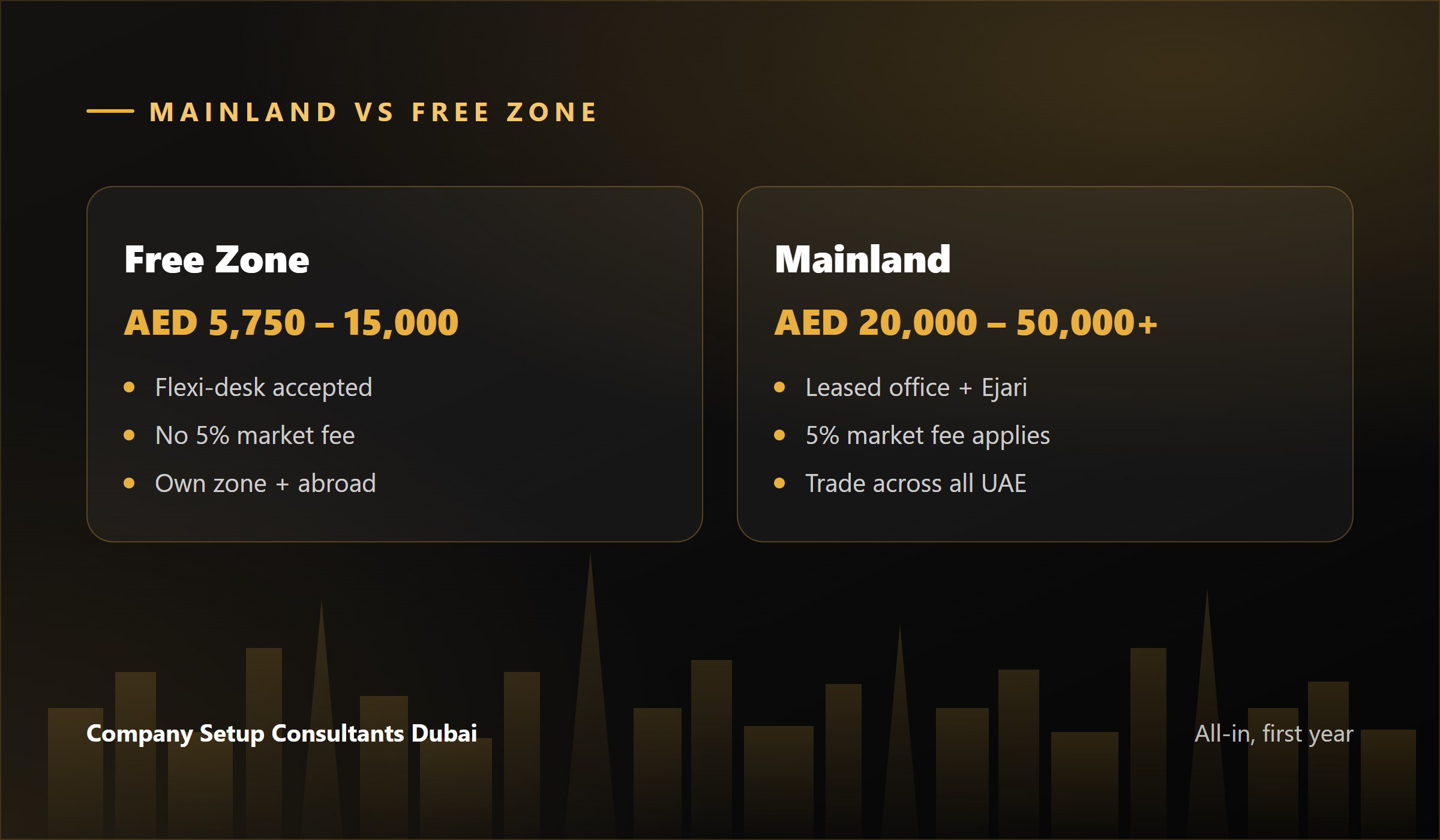
A free zone is usually cheaper to start, often from AED 5,750 to AED 15,000 all-in, because packages bundle the licence, a flexi-desk and one or two visas. Mainland costs more, typically AED 20,000 to AED 50,000, because you're paying for the right to trade across the entire UAE and a real office.
Cheaper isn't automatically better. A free zone company can't sell directly into the UAE mainland without a distributor or a dual licence, so if your customers are local shops and offices, the mainland saves you money later even though it costs more now. Match the lane to where you actually sell.
| Factor | Free zone | Mainland |
|---|---|---|
| Typical all-in first year | 5,750 – 15,000 | 20,000 – 50,000+ |
| Office | Flexi-desk accepted | Leased office + Ejari |
| Market fee (5% of rent) | None | Yes |
| Where you can trade | Own zone + abroad | All UAE + abroad |
| Ownership | 100% | Up to 100% |
What about offshore company costs?
An offshore company, like a JAFZA or RAK ICC entity, costs roughly AED 10,000 to AED 20,000 to set up, with no office lease and no visa fees because it can't be used to trade inside the UAE or sponsor residence. It's built for holding assets and international structuring, not operating locally.
Offshore looks cheap on paper, and it is, but only because you get less. There's no residence visa, no physical presence, and you can't sell into the UAE market. People confuse offshore with free zone constantly, and it's an expensive mix-up if you actually needed to live here or hire. The main costs are the registration fee, a registered agent, and annual renewal. Our offshore company formation page shows where it genuinely fits.
What does a free zone company cost, and which are cheapest?
Free zone company costs range from about AED 5,750 in the cheaper northern-emirates zones to AED 55,000 in premium Dubai zones like DMCC. IFZA and Meydan sit in the low-to-mid range for flexible general and services licences, while DMCC and DIFC price higher for their prestige and sector focus.
"Free zone" isn't one price. Each zone sets its own packages, and the gap between the cheapest and the priciest is enormous. A rough map of common zones:
| Free zone | Known for | Licence cost (AED / year) |
|---|---|---|
| RAKEZ (Ras Al Khaimah) | Cheapest entry point | 5,750 – 15,000 |
| IFZA (Dubai) | Flexible, low-cost general licences | 12,500 – 20,000 |
| Meydan (Dubai) | Fast, affordable services setups | 12,500 – 18,000 |
| Dubai South | Logistics, aviation, e-commerce | 15,000 – 40,000 |
| DMCC (Dubai) | Commodities, trading, crypto | 20,000 – 55,000 |
What actually moves a free zone package up or down is the number of visas, the desk type, and whether you want a physical office instead of a flexi-desk. Two companies in the same zone can pay very different amounts for the same licence because one took three visas and an office and the other took one visa and a desk. There's also the dual-licence option, where a free zone company adds a mainland licence to sell locally, which costs extra but is cheaper than forming a second company.
The cheapest zone isn't always the cheapest outcome. A zone that understands your sector, and whose licence names your exact activity, saves you amendment fees and headaches later. Compare them properly on our Dubai free zones overview and the wider free zones hub.
What are the hidden costs nobody quotes?
The commonly forgotten costs are the corporate bank account deposit, annual audit fees, PRO and service charges, sector approvals, and licence amendment fees. Together they can add AED 15,000 or more that never appears on the initial quote. Budget for them from the start.
This is where the billboard price and reality part ways. None of these are optional if they apply to you:
- Bank account minimum balance. Many UAE banks want an average balance of AED 10,000 to AED 50,000. It's not a fee, but it's cash you must park. See our corporate bank account guidance.
- Annual audit. From year two, many free zones and LLCs need audited financial statements, roughly AED 8,000 to AED 20,000. Corporate tax made clean books non-negotiable, which ties into accounting and bookkeeping.
- PRO and service fees. The setup agent's own fee, AED 3,000 to AED 10,000, plus ongoing document-clearing charges.
- Sector approvals. A restaurant needs Dubai Municipality and food-safety sign-off; a clinic needs the DHA. Each carries its own fee.
- Amendments. Adding an activity, changing shareholders or moving office each triggers a fee, which is why choosing right the first time is cheaper.
Why do these stay hidden? Because they're not part of the setup transaction the agent is selling, so they fall outside the quote. The audit hits in year two. The bank balance is your own cash, not a fee. The municipality approval only applies to certain activities. Each one is easy to leave off a headline price, and together they're the difference between the number you were quoted and the number you actually spend. A realistic budget assumes the quote is the floor, not the ceiling.
How much does it cost to renew a Dubai business each year?
Annual renewal costs roughly AED 8,000 to AED 25,000, usually 80% to 100% of your original licence fee plus your office renewal, the establishment card, and any visa renewals due. The licence must be renewed every year or you face fines and, eventually, a blocked licence.
Setup is a one-time cost; the licence is a recurring one. People budget for year one and forget year two exists. What lands on your desk annually:
- Trade licence renewal, close to the original licence fee.
- Office or flexi-desk renewal, plus the 5% market fee on the mainland.
- Establishment card renewal, around AED 1,200 to AED 2,000.
- Visa renewals every two years, per person.
- Late renewal fines start around AED 250 and climb, so don't let it lapse.
Penalties are worth taking seriously. Operating on an expired licence can draw fines in the thousands, and letting it lapse long enough can freeze the company and block visa renewals for your staff. The renewal is boring and easy to forget, which is exactly why it bites people. Diarise it a month before the expiry date, not on it.
What ongoing costs come after you launch?
Beyond renewal, budget for corporate tax at 9% on profits above AED 375,000, VAT at 5% once turnover passes AED 375,000, and accounting or audit fees of roughly AED 8,000 to AED 20,000 a year. These are the true cost of running the company, not just opening it.
Setup is the entry ticket; the tax and compliance layer is the season pass. Since June 2023 the UAE charges federal corporate tax, so "tax-free Dubai" is only half true now, and pretending otherwise gets founders fined.
- Corporate tax. 9% on annual profit above AED 375,000, and 0% below it. Every company must still register with the Federal Tax Authority even at 0%, and missing the deadline carries an AED 10,000 penalty. Details on our corporate tax registration page.
- VAT. 5%, mandatory once taxable turnover crosses AED 375,000 a year. Once registered you file returns and keep records, covered under VAT registration and filing.
- Accounting and audit. Clean books are now non-negotiable for tax, and many companies need audited statements yearly. Bundling accounting and bookkeeping from month one is cheaper than reconstructing it at tax time.
None of this shows up on a setup quote, but it's real money every year. Factor it in before you decide what you can afford.
What do real businesses actually pay? Three examples
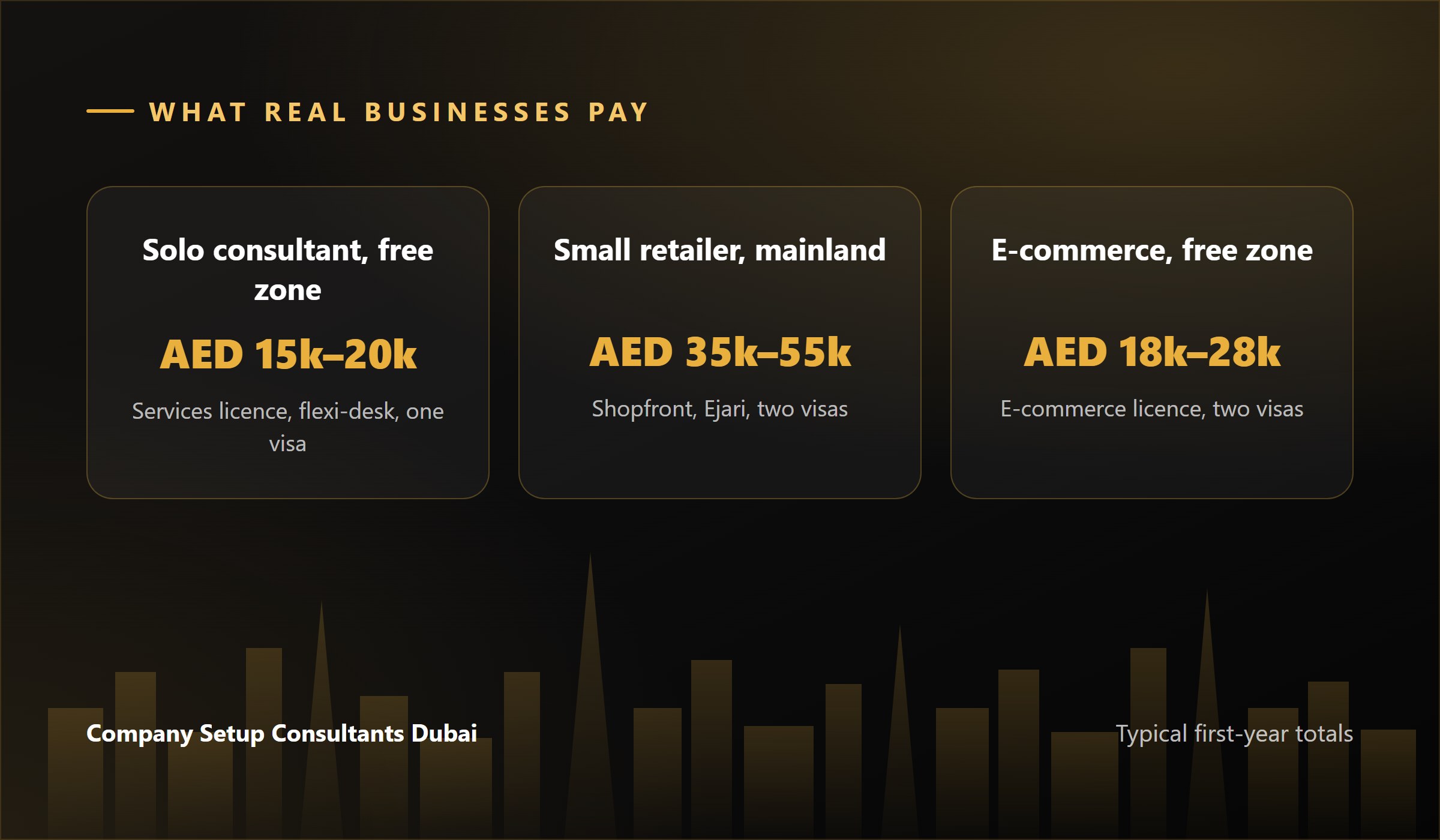
A solo consultant in a free zone pays around AED 15,000 to AED 20,000 in year one. A small mainland retailer pays AED 35,000 to AED 55,000. An e-commerce startup in a free zone pays about AED 18,000 to AED 28,000. The gap comes down to office and visas, not the licence.
Ranges are useful, but real numbers land better. Three typical first-year scenarios, all in dirhams:
- Solo consultant, free zone (~AED 15,000–20,000). A professional services licence in IFZA or Meydan, a flexi-desk, and one investor visa. No market fee, no leased office. The lean, popular starting point.
- Small retailer, Dubai mainland (~AED 35,000–55,000). A commercial licence, a small leased shopfront with Ejari, the 5% market fee, one investor visa plus one staff visa, and Dubai Municipality sign-off. The mainland premium buys direct UAE trade.
- E-commerce startup, free zone (~AED 18,000–28,000). An e-commerce licence in a zone like Dubai South or IFZA, a flexi-desk, two visas, and a payment-gateway-ready bank account. More visas than the consultant, no shopfront like the retailer.
To make it concrete, here's the small mainland retailer itemised, so you can see where AED 45,000 actually goes:
| Line item | Cost (AED) |
|---|---|
| Commercial trade licence | 18,000 |
| Name reservation + initial approval + MOA | 3,000 |
| Small leased shopfront + Ejari | 15,000 |
| Market fee (5% of rent) | 750 |
| Establishment card + investor visa | 6,000 |
| One staff visa | 4,500 |
| Dubai Municipality approval | 1,500 |
| First-year total | ~48,750 |
Notice the licence is a similar size in all three scenarios. What separates them is the office and the visa count, exactly the two dials from earlier. If you want a tailored figure, our business setup service quotes the full stack, not just the licence.
When do you actually pay for all this?
Most costs land upfront during setup: the name, approval, MOA, licence and office are due before the licence is issued. Visas follow once the company exists. Renewal, audit and tax are ongoing, hitting annually. So the first year is front-loaded, then it settles.
The timing matters for cash flow. You can't drip-feed the setup; the government fees and the licence are due before you're trading, and the office lease usually wants a year paid or post-dated cheques. The visa stack comes next, after the licence. Only from year two do the recurring costs, renewal, audit and any tax, spread across the calendar. Plan the first-year cash outlay as a lump, not a monthly bill.
How can you reduce your Dubai business setup cost?
Cut costs by starting in a free zone with a flexi-desk, taking only the visas you need on day one, choosing the exact activity to avoid amendments, and skipping premium zones unless your sector needs them. The biggest savings come from the office and visa decisions, not from haggling the licence.
A few levers that genuinely move the number:
- Start lean with a flexi-desk instead of a leased office; upgrade when revenue justifies it.
- Take one visa now, add more when you actually hire. Every visa is recurring, not just upfront.
- Pick your activity precisely so you never pay to amend the licence later.
- Compare zones on total cost, not the headline licence, and avoid premium zones unless the prestige earns its keep.
- Keep clean books from month one so audit and corporate tax don't become emergency spends, which ties into corporate tax compliance.
One more saving that pays for itself: don't overbuy the licence. Founders sometimes take a general trading licence "to be safe" when a narrower commercial or professional licence covers everything they'll actually do for AED 5,000 less. You can always add activities later. Buy for the business you're starting, not the empire you're daydreaming about.
Cheapest possible and right-for-you aren't always the same thing. Spend where it protects the business, save where it's just vanity.
Frequently Asked Questions
How much does it cost to start a small business in Dubai?
A small business typically costs AED 12,500 to AED 30,000 in the first year, covering the licence, government fees, a flexi-desk or small office, and one investor visa. Free zone packages sit at the lower end.
What is the cheapest way to set up a business in Dubai?
The cheapest route is a free zone package with a flexi-desk and one visa, starting around AED 5,750 in the more affordable zones. It suits online, consultancy and export businesses that don't need to trade directly on the mainland.
How much is a Dubai trade licence?
A mainland trade licence costs roughly AED 10,000 to AED 25,000 a year depending on type, with professional licences cheapest and general trading dearest. Free zone licences start near AED 5,750.
Is there a minimum capital requirement to start a company in Dubai?
Most Dubai activities have no fixed minimum paid-up capital, so you don't have to deposit a set sum to form the company. Some regulated or specific activities still require declared capital; check your activity before assuming.
How much does it cost to renew a Dubai business licence?
Annual renewal runs roughly AED 8,000 to AED 25,000, usually 80% to 100% of the original licence fee plus office renewal, the establishment card and any visa renewals. Late renewal adds fines.
Are there hidden costs in Dubai business setup?
Yes. The common surprises are the bank account minimum balance, annual audit fees, PRO and service charges, sector approvals, and amendment fees, which together can add AED 15,000 or more beyond the quoted licence.
How much does a free zone company cost in Dubai?
Free zone companies range from about AED 5,750 in cheaper zones to AED 55,000 in premium Dubai zones like DMCC. IFZA and Meydan sit in the low-to-mid range for flexible licences.
Do I have to pay for a visa when setting up in Dubai?
Only if you want residence. You can own a company without a visa, but an investor visa costs around AED 3,500 to AED 5,000 including medical and Emirates ID, and it's usually needed to live here or open banking smoothly.


