

For years the pitch for the UAE was simple: come here, keep what you earn, pay no tax. Then June 2023 happened. UAE corporate tax arrived at 9%, and a lot of business owners who set up under the old "tax-free" banner are still catching up, some of them the hard way, through an AED 10,000 penalty for missing a registration they didn't know they had to file.
Here's the part that trips people up most: the rate is low, but the rules aren't optional. Corporate tax was introduced by Federal Decree-Law No. 47 of 2022 and applies to profits above AED 375,000 (UAE Ministry of Finance), yet every company has to register with the Federal Tax Authority even if it owes nothing. "I'm under the threshold" is not a reason to skip it.
This guide explains UAE corporate tax in plain terms, who pays the 9% and who pays 0%, how free zones fit in, the deadlines and penalties, and a worked example so you can see exactly what a real company owes. No jargon, no scare tactics.
What is UAE corporate tax?
UAE corporate tax is a federal tax on business profits, introduced in June 2023 under Federal Decree-Law No. 47 of 2022. It's charged at 0% on taxable income up to AED 375,000 and 9% on profit above that. It applies to mainland and free zone companies alike, though qualifying free zone income can stay at 0%.
It's a business tax, not a personal one, so this is important: there's still no personal income tax in the UAE. What you draw as salary or dividends isn't taxed. What's taxed is the company's profit, and only the slice above the threshold. That design keeps the effective rate low, especially for small businesses, while bringing the UAE in line with global tax standards.
The tax is administered by the Federal Tax Authority (FTA), the same body that runs VAT. If you already deal with the FTA for VAT, the corporate tax portal will feel familiar.
Why did the UAE introduce it at all? Two reasons, mainly. It diversifies government income away from oil, and it meets international standards on tax transparency, keeping the UAE off grey lists and inside the global system. Crucially, the 9% headline was set deliberately low, one of the lowest corporate tax rates in the world, so the country stays competitive for business while still collecting. The message from policymakers was clear: the UAE is joining the global tax framework, not abandoning its low-tax appeal.
Who pays 9% corporate tax, and who pays 0%?
You pay 0% on the first AED 375,000 of annual taxable profit and 9% on everything above it. Mainland companies and non-qualifying free zone companies pay this. Qualifying free zone companies can keep 0% on qualifying income, and some small businesses can elect 0% under Small Business Relief. Everyone still registers.
The headline is a two-band system, and it's genuinely generous at the bottom. Here's who sits where:
| Business | Taxable profit | Corporate tax rate |
|---|---|---|
| Any company | Up to AED 375,000 | 0% |
| Mainland company | Above AED 375,000 | 9% |
| Free zone (non-qualifying) | Above AED 375,000 | 9% |
| Free zone (qualifying, QFZP) | Qualifying income | 0% |
| Small Business Relief (until end 2026) | Revenue under AED 3m | 0% (elected) |
Large multinationals with global revenue above the OECD threshold face a separate 15% minimum under Pillar Two rules, but that's a small club. For almost every business reading this, the numbers that matter are 0%, 9% and AED 375,000.
The AED 375,000 threshold, with a worked example
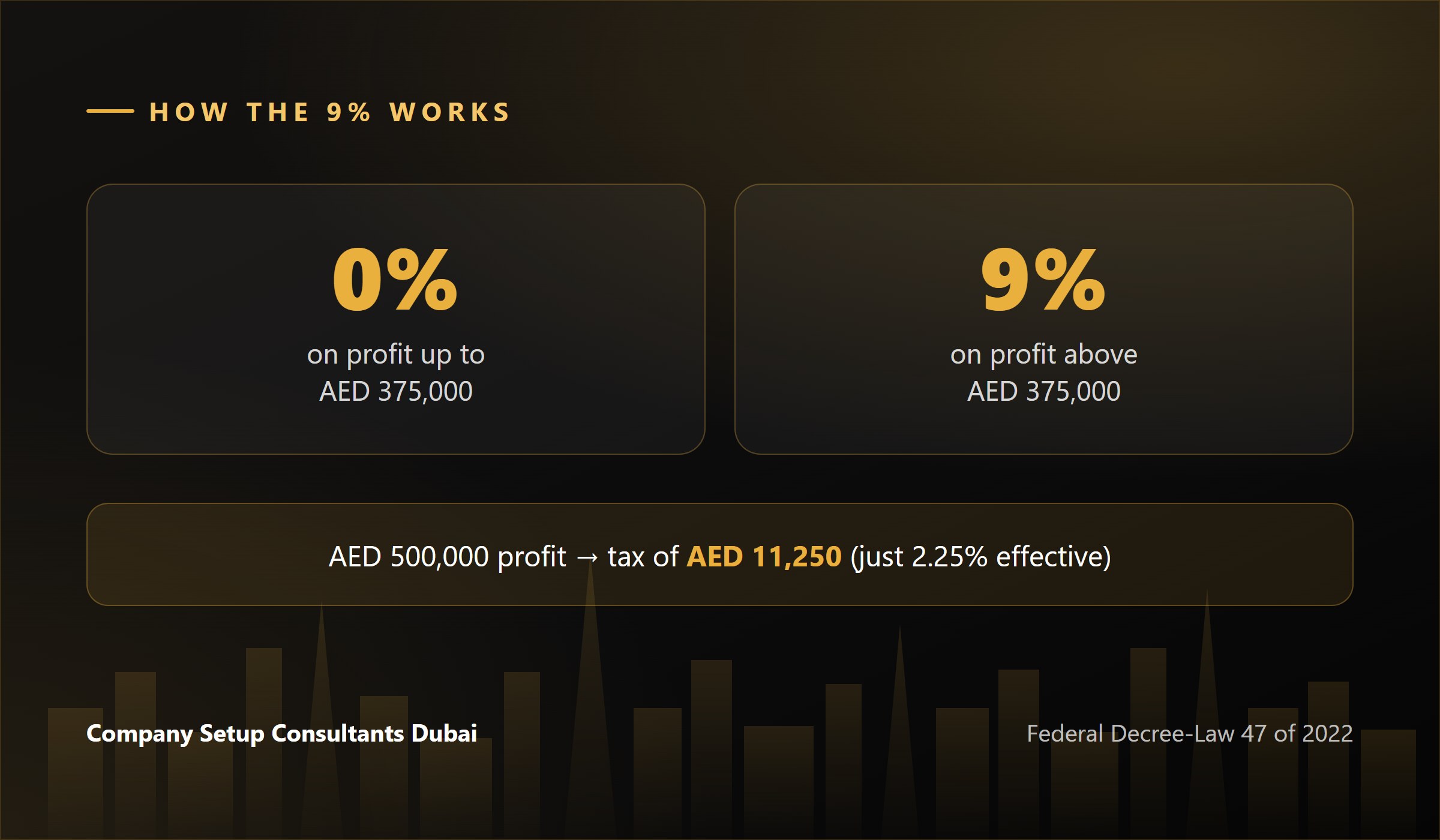
The threshold works like a tax-free allowance, not a cliff. Only the profit above AED 375,000 is taxed, not the whole amount, which surprises a lot of first-time owners who assume crossing the line taxes everything.
Take a company with AED 500,000 in taxable profit. The first AED 375,000 is taxed at 0%, and only the remaining AED 125,000 is taxed at 9%, giving a bill of AED 11,250. That's an effective rate of just 2.25% on total profit. Even a company earning AED 1 million pays 9% on AED 625,000, or AED 56,250, an effective 5.6%. The rate stays gentle until profits get large.
Do free zone companies pay corporate tax?
Free zone companies are not automatically tax-free. A Qualifying Free Zone Person (QFZP) keeps 0% on qualifying income, but only if it meets strict conditions. Any non-qualifying income is taxed at 9%, without the AED 375,000 allowance. Free zone status is a benefit you have to earn and maintain, not a default.
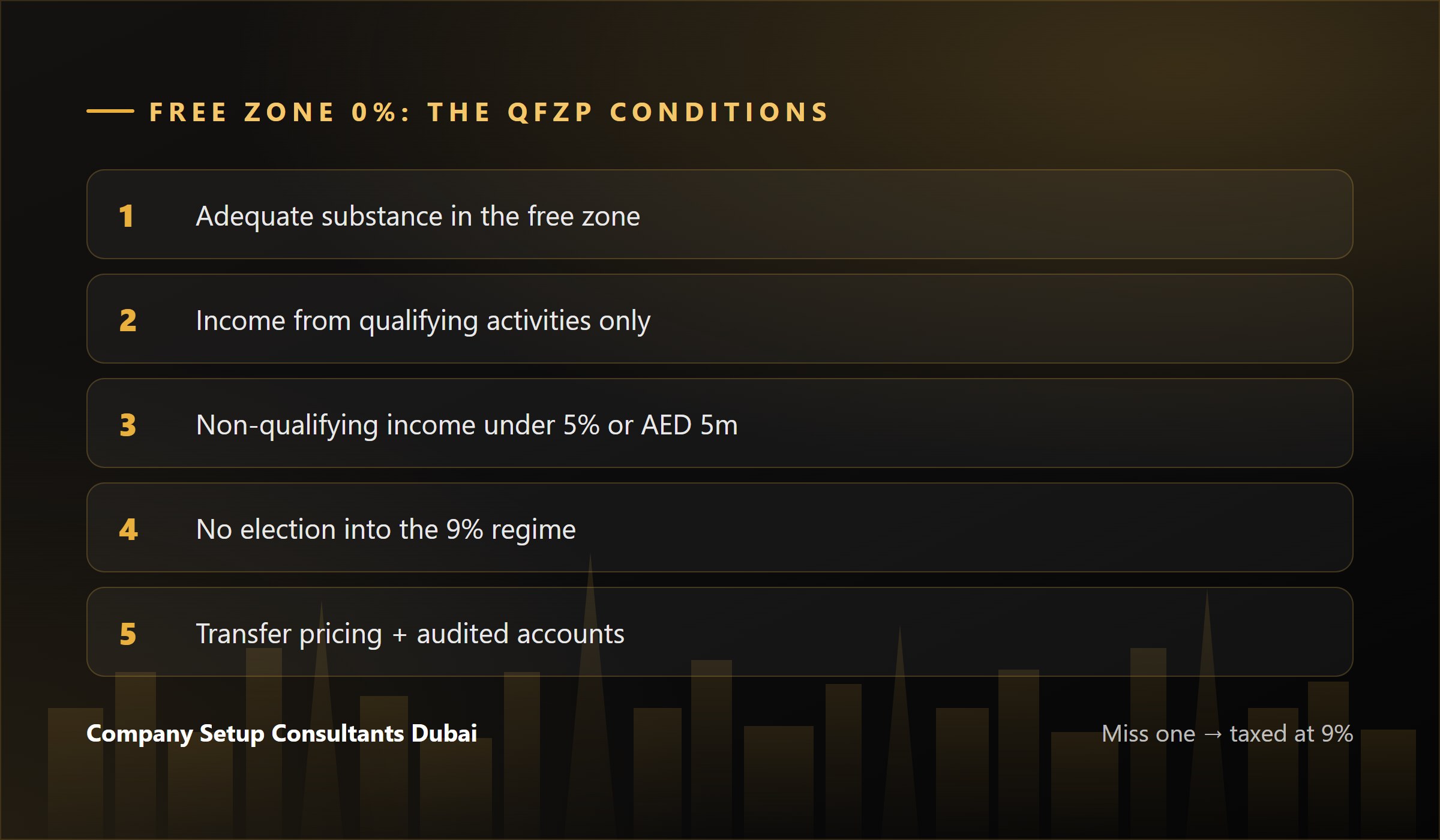
This is the single most misunderstood part of the whole system. People form in a free zone assuming "0% forever," then find that the 0% is conditional and can be lost. To keep QFZP status and the 0% rate, your company must meet all of these:
- Adequate substance in the free zone: real staff, real operating expenditure, and core decisions made in the UAE. A letterbox won't do.
- Qualifying income only: income mainly from dealings with other free zone entities and foreign clients, within the list of qualifying activities.
- The de minimis test: non-qualifying income must stay under 5% of total revenue, or AED 5 million, whichever is lower.
- No election out: you haven't opted into the standard 9% regime.
- Transfer pricing and audited accounts: arm's-length documentation and audited financial statements.
A quick example shows how it bites. Say a free zone consultancy earns AED 2 million, of which AED 150,000 comes from UAE mainland clients (non-qualifying). That AED 150,000 is 7.5% of revenue, over the 5% de minimis limit, so the company can lose QFZP status entirely and be taxed at 9% on all of it, not just the mainland slice. One overlooked income stream, a much bigger bill.
Break one condition and the whole 0% can fall away. It's worth getting proper advice here rather than assuming, because the difference between qualifying and not is the difference between 0% and 9% on your whole profit. We cover the detail on our corporate tax registration page, and the wider trade-offs in our mainland vs free zone vs offshore guide.
What is Small Business Relief?
Small Business Relief lets a business with annual revenue under AED 3 million elect to be treated as having no taxable income, so it pays 0% corporate tax. It's a genuine break for small companies, but it's temporary: under current rules it's available only through 31 December 2026.
This one is time-sensitive, so read it carefully. If your revenue is under AED 3 million, you can currently elect Small Business Relief and pay nothing, even on profit above AED 375,000. It's designed to shield startups and small firms from the compliance cost of tax while they grow.
The catch is the expiry. As the rules stand, Small Business Relief applies to tax periods ending on or before 31 December 2026, so it won't be there forever. If you're relying on it, plan for the day it ends and your profit above AED 375,000 becomes taxable at 9%. Don't build a business model on a relief with a known end date.
Who must register for corporate tax, and by when?
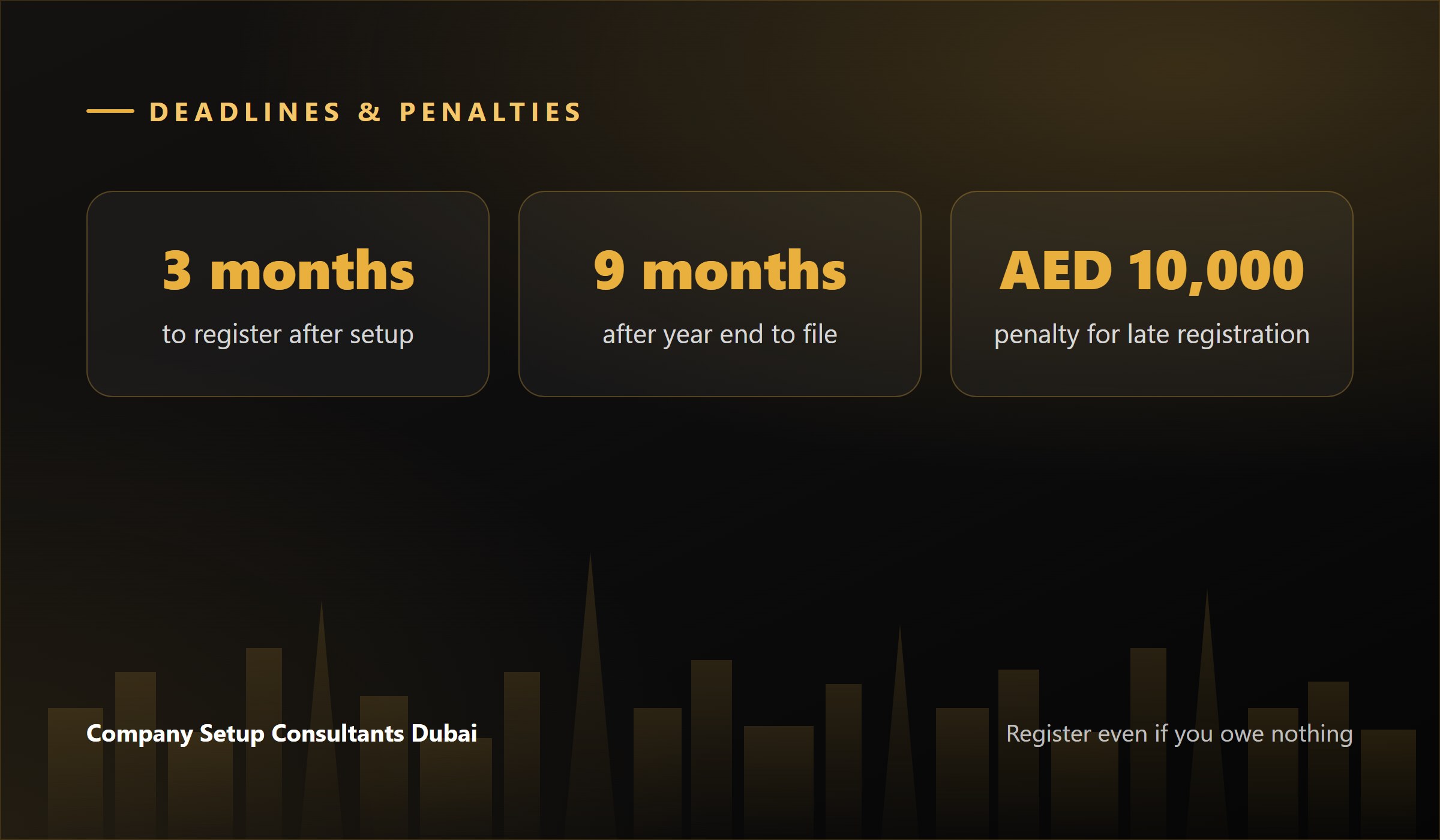
Every taxable business in the UAE must register for corporate tax with the FTA, even free zone companies and those earning under the threshold. New companies generally must register within three months of incorporation. Missing the registration deadline carries a fixed AED 10,000 penalty.
Let's kill the biggest myth right now: registration is mandatory for everyone, regardless of whether you owe tax. A free zone company at 0%, a small business under the threshold, a brand-new startup with no revenue yet, all of them must register and obtain a corporate tax registration number.
Deadlines depend on when you were set up. Companies formed before the rules staggered their deadlines by licence issue month. Newer companies generally have three months from incorporation to register. Whatever your date, the penalty for missing it is a flat AED 10,000, and it's one of the most common fines being issued right now precisely because owners assume "no tax due" means "nothing to file." Our team handles registration on the corporate tax registration service so the deadline doesn't slip.
When do you file, and what are the penalties?
You file one corporate tax return per year, due within nine months of your financial year end. For a December year end, that means a 30 September deadline. Late filing and payment carry escalating penalties on top of the AED 10,000 late-registration fine, so the calendar matters.
Corporate tax is filed annually, not quarterly like VAT, which keeps the admin lighter. The return is due nine months after your financial year closes, so a company with a calendar year end files by 30 September the following year. You calculate taxable profit from your accounts, apply the threshold and any relief, and pay what's owed.
The penalties stack if you slip. Beyond the AED 10,000 for late registration, there are fines for late filing, late payment and errors, which climb the longer they're left. None of it is dramatic if you stay organised, and all of it is avoidable with clean books and a note in the diary. That's why we bundle accounting and bookkeeping with tax for most clients, keeping the records ready before the deadline.
How do you register and file corporate tax?
You register through the FTA's EmaraTax portal using your trade licence and company details, then receive a corporate tax registration number. Each year you prepare accounts, calculate taxable profit, file the return online within nine months of your year end, and pay any tax due. Most businesses use an accountant or tax agent.
The process itself is straightforward once you know the steps:
- Register on EmaraTax with your trade licence, Emirates ID and company details to get your corporate tax registration number.
- Keep proper accounts through the year, since the return is built from your bookkeeping, not guesswork.
- Calculate taxable profit by adjusting your accounting profit for allowable expenses, exemptions and any relief.
- File the return online within nine months of your financial year end.
- Pay any tax due by the same deadline.
None of it is heavy for a small company with clean books, which is the whole point, keep the records tidy and filing is a formality. Our corporate tax registration service handles the FTA side end to end.
How is corporate tax different from VAT?
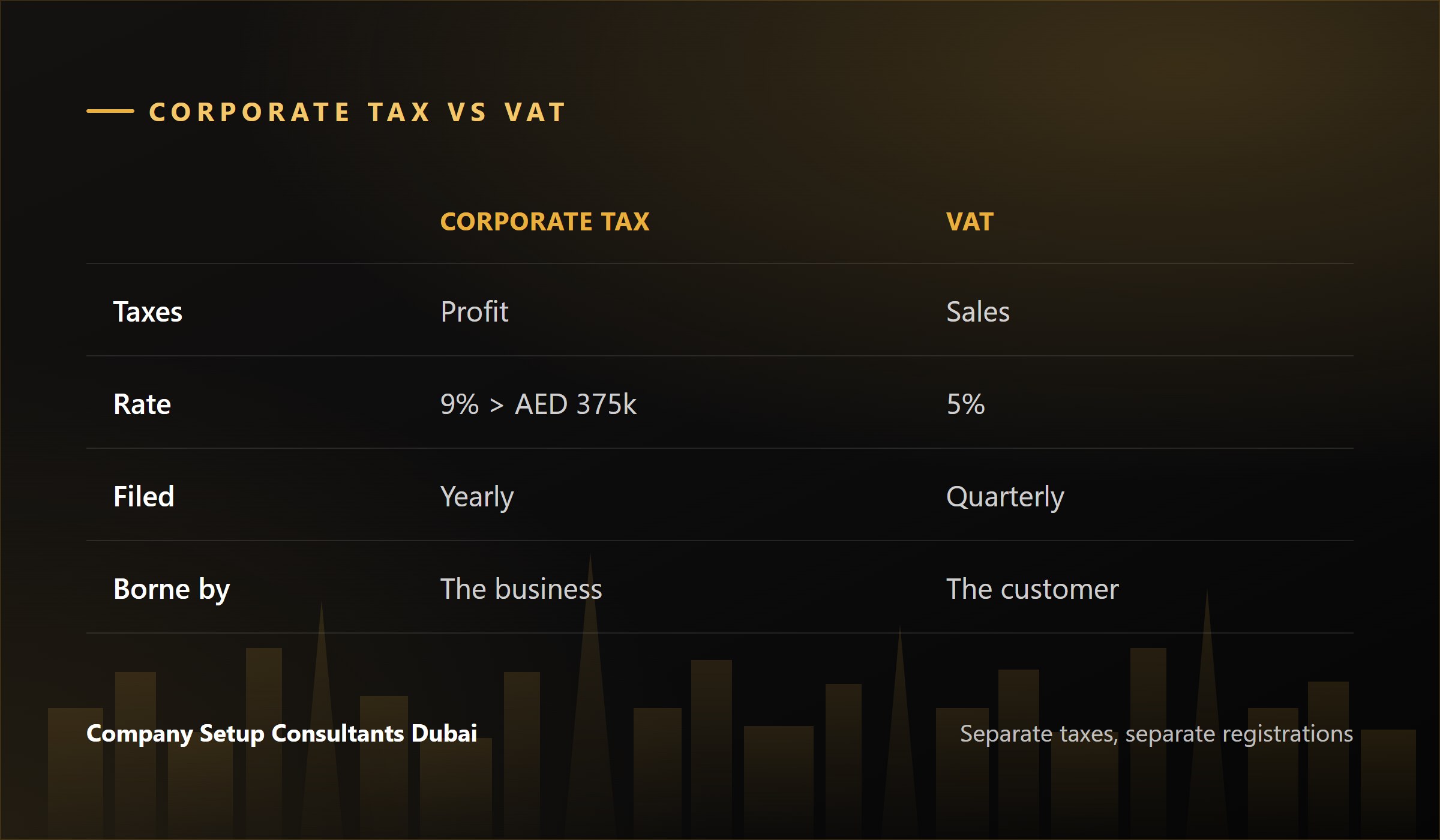
Corporate tax is a 9% tax on annual profit, filed once a year, paid by the business. VAT is a 5% tax on sales, filed quarterly, collected from customers and passed to the FTA. They're separate taxes with separate registrations, and a company can owe one, both, or neither.
People blur the two because the same authority runs both, but they work very differently:
| Corporate tax | VAT | |
|---|---|---|
| What's taxed | Business profit | Sales of goods/services |
| Rate | 9% above AED 375,000 | 5% |
| Registration trigger | All businesses | Turnover over AED 375,000 |
| Filing frequency | Yearly | Quarterly (usually) |
| Who bears it | The business | The end customer |
The overlap in thresholds is a coincidence worth noting: AED 375,000 is both the corporate tax profit allowance and the mandatory VAT turnover line, but they measure different things, profit versus sales. You handle VAT on the VAT registration and filing service, and it's entirely possible to owe VAT but no corporate tax, or the reverse.
Should corporate tax change where you set up?
For most small businesses, no. The 0% band up to AED 375,000 and low effective rates mean corporate tax rarely decides mainland versus free zone on its own. It matters more for high-margin businesses that can genuinely meet the QFZP conditions and keep income qualifying, where the free zone 0% is worth structuring for.
It's tempting to chase the free zone 0% as the deciding factor, but be honest about whether you'd actually qualify. Many businesses selling to UAE mainland customers can't keep their income "qualifying," so they'd pay 9% in a free zone anyway, the same as mainland, while giving up the right to trade locally. In that case the tax angle is a wash and the decision comes back to where your customers are. Our mainland vs free zone vs offshore guide works through that choice, and the cost of business setup in Dubai covers the fees. Let tax inform the decision, not dominate it.
What can you deduct before tax?
You're taxed on profit, not revenue, so ordinary business expenses reduce what you owe. Salaries, rent, marketing, software and other costs incurred wholly for the business are generally deductible. Some items, like certain entertainment costs and fines, are restricted or disallowed. Clean records are what make the deductions stick.
This is where good bookkeeping pays for itself. Corporate tax is charged on taxable profit, which is your revenue minus allowable expenses, so every legitimate cost you record lowers the taxable amount. Broadly, what comes off the top and what doesn't:
- Generally deductible: salaries and staff costs, office rent, marketing, software and subscriptions, professional and legal fees, and other costs incurred wholly for the business.
- Restricted or disallowed: a portion of entertainment expenses, fines and penalties, and payments that aren't at arm's length between related parties.
- Losses: business losses can generally be carried forward to offset future taxable profit, subject to the rules, softening a bad year.
The cleaner your accounts, the more confidently you can claim what you're entitled to and the easier an FTA review becomes. Audited or well-kept books also matter for free zone companies chasing QFZP status, which is why audit and accounting sit close to tax. Skimp on the record-keeping and you effectively overpay, because expenses you can't prove are expenses you can't deduct.
What corporate tax mistakes do businesses make?
The common mistakes are skipping registration because no tax is due, assuming a free zone means automatic 0%, relying on Small Business Relief past its 2026 expiry, keeping poor records that inflate taxable profit, and missing the filing deadline. Each one is avoidable and each one costs money.
A few worth calling out plainly:
- "I'm under the threshold, so I don't register." Wrong, and it's the AED 10,000 penalty everyone's getting. Registration is mandatory regardless of tax owed.
- "Free zone means 0% automatically." Only if you're a QFZP and keep income qualifying. Non-qualifying income is taxed at 9% with no allowance.
- Leaning on Small Business Relief long-term. It's scheduled to end after 2026, so it's a bridge, not a foundation.
- Messy books. Poor records mean missed deductions and a higher bill, plus a harder time if the FTA ever reviews you.
Almost all of it comes down to treating corporate tax as optional or automatic. It's neither. A little organisation, or a good accountant, removes the risk entirely.
Frequently Asked Questions
What is the corporate tax rate in the UAE?
The UAE corporate tax rate is 0% on taxable profit up to AED 375,000 and 9% on profit above that. Qualifying free zone companies can keep 0% on qualifying income, and there's no personal income tax.
Do I have to register for corporate tax if I earn under AED 375,000?
Yes. Registration with the Federal Tax Authority is mandatory for all businesses, including those below the threshold and free zone companies at 0%. Missing the deadline carries a fixed AED 10,000 penalty.
Do free zone companies pay UAE corporate tax?
Not necessarily. A Qualifying Free Zone Person keeps 0% on qualifying income if it meets all the conditions, including substance and the de minimis test. Any non-qualifying income is taxed at 9% without the AED 375,000 allowance.
How much corporate tax will I pay on AED 500,000 profit?
You'd pay AED 11,250. The first AED 375,000 is taxed at 0% and the remaining AED 125,000 at 9%, giving an effective rate of just 2.25% on total profit.
What is Small Business Relief?
Small Business Relief lets a business with revenue under AED 3 million elect to pay 0% corporate tax. Under current rules it's available only for tax periods ending on or before 31 December 2026.
When is the corporate tax return due?
The corporate tax return is due within nine months of your financial year end. For a December year end, that means 30 September the following year. It's filed once a year, unlike VAT.
What's the penalty for late corporate tax registration?
Late registration carries a fixed AED 10,000 penalty. Late filing and late payment add further escalating fines, so registering and filing on time is far cheaper than catching up later.
Is corporate tax the same as VAT?
No. Corporate tax is a 9% tax on annual profit paid by the business. VAT is a 5% tax on sales collected from customers and filed quarterly. They're separate taxes with separate registrations.


