

There's no single "best" free zone in Dubai, and any consultant who says otherwise is quietly steering you toward the one that pays them the fattest commission. The best free zone in Dubai is the one that fits your activity, your budget, and how many visas you need. For a solo consultant that might be Meydan; for a commodities trader it's almost certainly DMCC; for a fintech it's DIFC. Different businesses, different winners.
That's the problem with most "top free zones" lists: they rank zones as if every business were the same. Dubai has over 20 free zones of its own, part of more than 40 across the UAE (UAE Ministry of Economy), and DMCC alone has been named the world's number-one free zone for nine years running by the Financial Times' fDi Intelligence. Plenty of good options, which is exactly why the choice feels overwhelming.
This guide compares the major Dubai free zones on the things that actually decide it, cost, sector fit, visa quota and banking, then tells you which one suits which business. Real 2026 figures, no billboard pricing.
What are the best free zones in Dubai?
The best Dubai free zones in 2026 are IFZA and Meydan for low-cost flexible setups, DMCC for trading and banking, DIFC for finance, JAFZA and Dubai South for logistics, and DAFZA for high-value trade. Each leads a different niche, so the right one depends on your activity and budget.
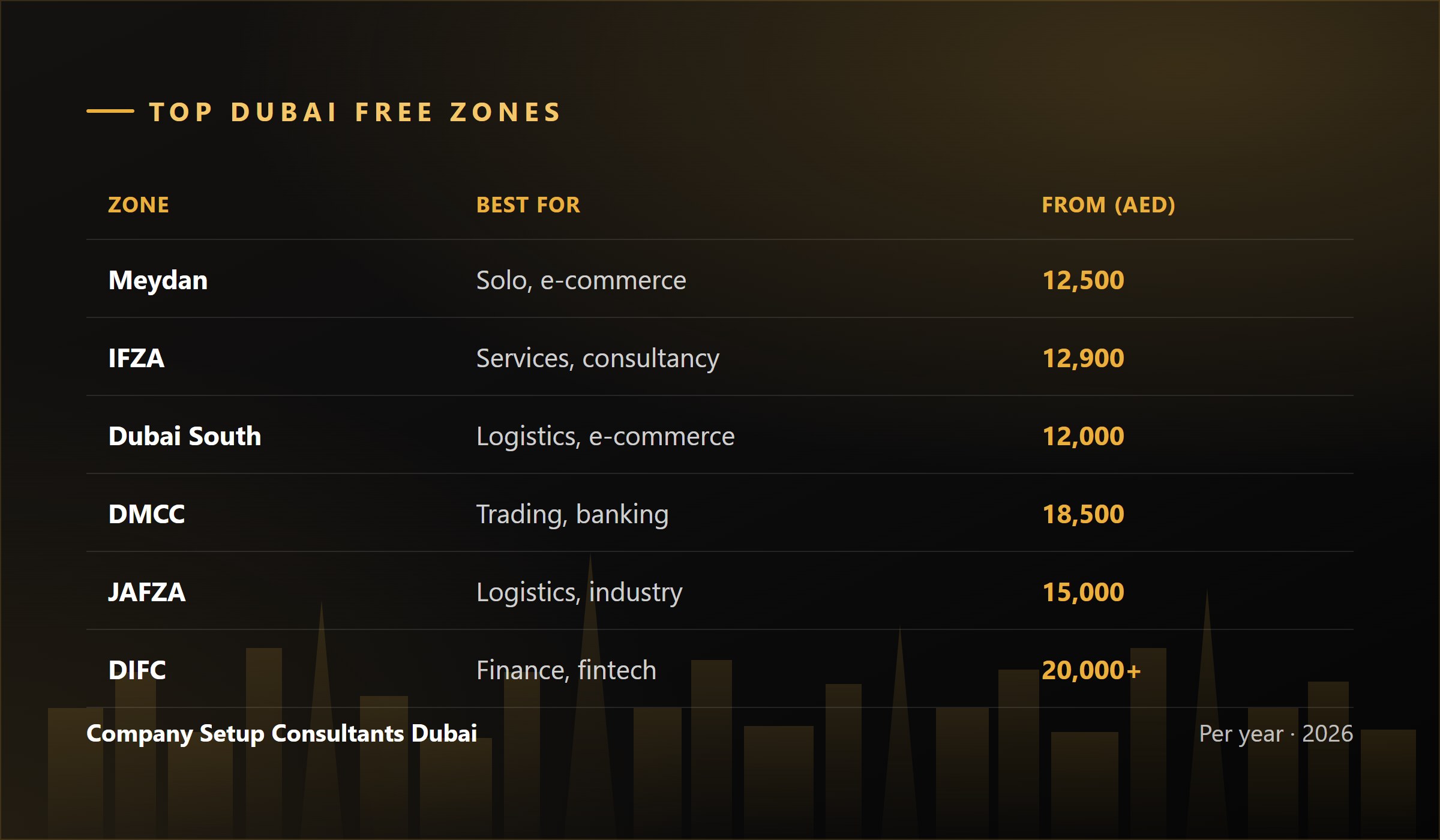
Rather than crown one, it's more useful to see them side by side. Here's how the headline Dubai zones stack up on cost, focus and visas.
| Free zone | Best for | From (AED/year) | Visa quota |
|---|---|---|---|
| Meydan | Solo founders, e-commerce, prestige address | 12,500 | Flexible |
| IFZA | Low-cost services, trading, consultancy | 12,900 | Flexible |
| Dubai South | Logistics, aviation, e-commerce | 12,000 | Scaled to office |
| DMCC | Trading, commodities, crypto, banking | 18,500 | Scaled to office |
| JAFZA | Logistics, industry, port trade | 15,000 | Scaled to office |
| DAFZA | Aviation, high-value trade | 25,000 | Scaled to office |
| DIFC | Finance, fintech, legal | 20,000+ | Scaled to office |
Notice how far apart the cheapest and priciest sit, roughly AED 12,000 to over AED 25,000 just to start. That gap is the whole reason the choice matters. Browse every option on our Dubai free zones hub, and if you're still weighing free zone against the alternatives, our guide on mainland vs free zone vs offshore covers that decision.
What do you actually get with a Dubai free zone?
Every Dubai free zone gives you 100% foreign ownership, full profit repatriation, a fast digital setup, and a package that usually bundles the licence, a flexi-desk and visas. Qualifying companies also get 0% corporate tax on qualifying income. These benefits are common to all zones, so they're not what you're choosing between.
It helps to separate what's standard from what varies. Standard across the board:
- 100% ownership with no local partner, always.
- Full repatriation of capital and profits, no restrictions.
- 0% corporate tax on qualifying income if you meet the QFZP conditions.
- Bundled packages pairing the licence with a desk and one or more visas.
- Fast, largely digital setup, often a few working days.
What actually differs between zones is cost, sector focus, visa quota, address prestige and banking strength. Those five are the real decision, which is why the rest of this guide keeps coming back to them.
Which is the cheapest free zone in Dubai?
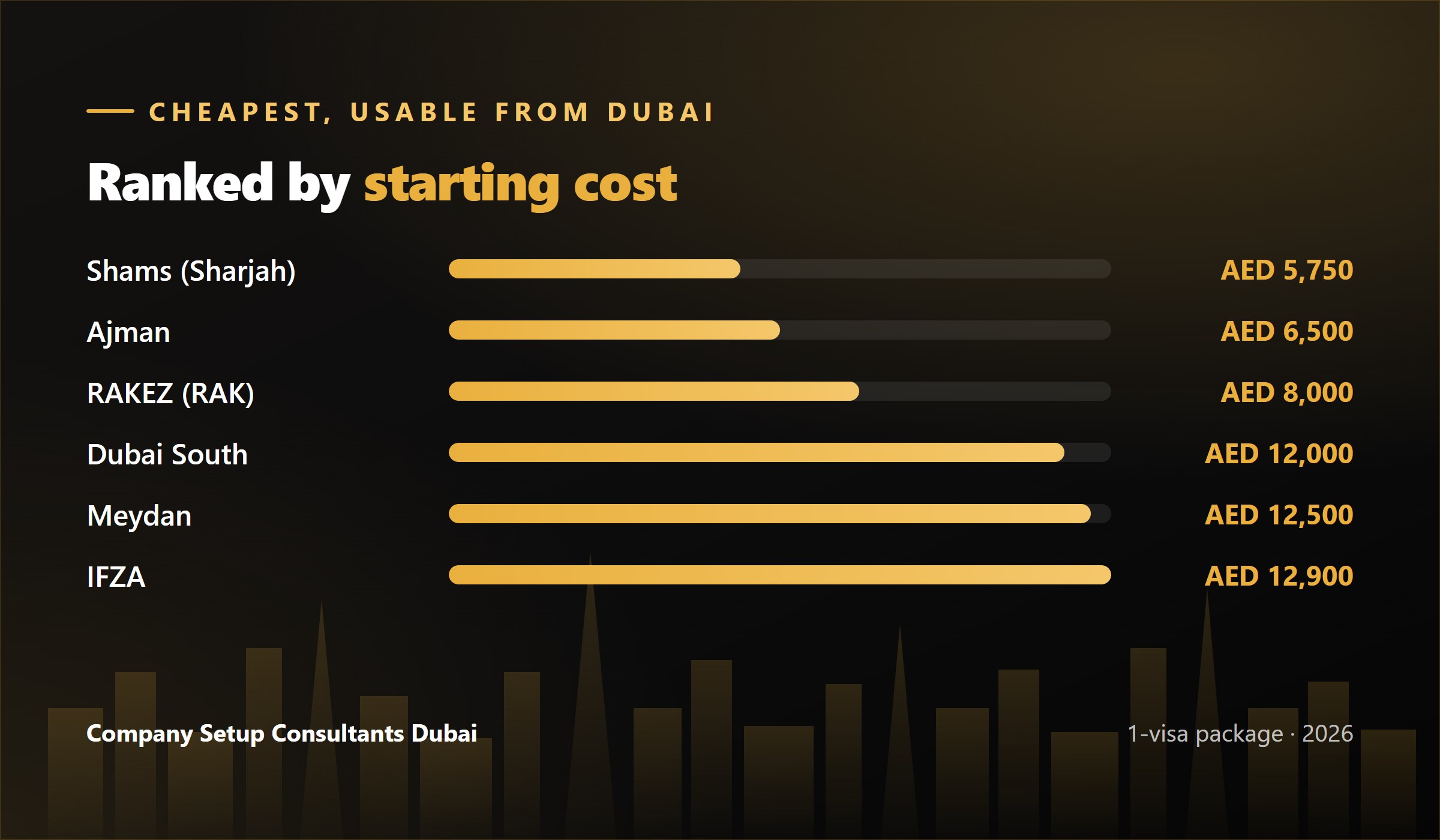
Meydan and IFZA are the cheapest Dubai free zones, from around AED 12,500 and AED 12,900 for a one-visa package. For the lowest cost overall, the northern-emirates zones beat them, Shams from AED 5,750, Ajman from AED 6,500, and RAKEZ from about AED 8,000, all usable from Dubai.
If price is your first filter, it helps to see the ladder. Cheapest first:
| Free zone | Emirate | From (AED/year) |
|---|---|---|
| Shams | Sharjah | 5,750 |
| Ajman Free Zone | Ajman | 6,500 |
| RAKEZ | Ras Al Khaimah | 8,000 |
| Dubai South | Dubai | 12,000 |
| Meydan | Dubai | 12,500 |
| IFZA | Dubai | 12,900 |
A word of caution on cheapest, though. A northern-emirates licence is fine if you operate online or abroad, but it doesn't carry a Dubai address, which some clients and banks quietly prefer. And the sticker price is a one-visa package; add visas or an office and the cheap zone can lose its lead. Compare the northern options on our northern-emirates free zones page.
Which free zone is best for your business type?
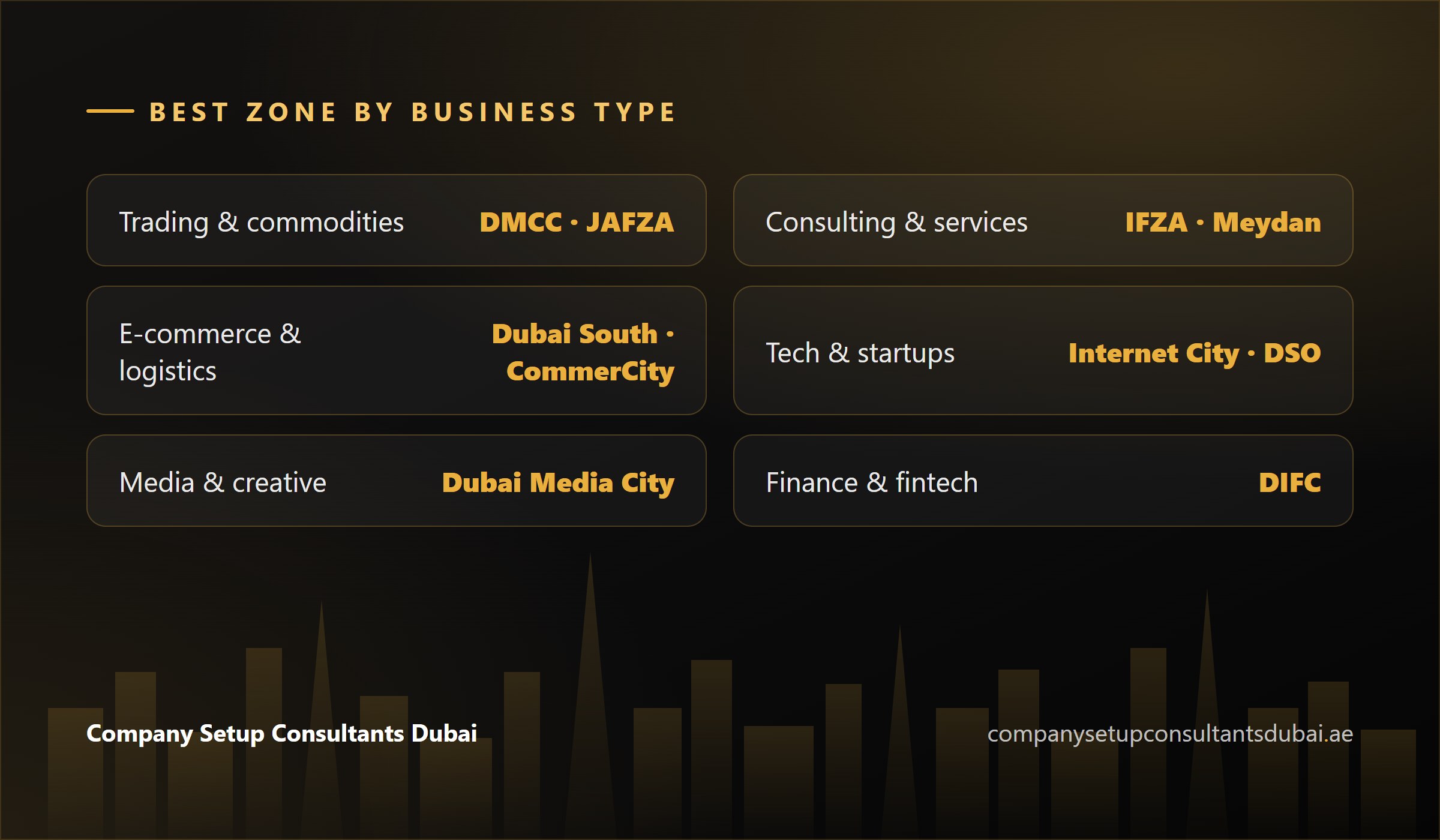
Match the zone to your activity: DMCC or JAFZA for trading, IFZA or Meydan for consulting and services, Dubai South or Dubai CommerCity for e-commerce and logistics, Dubai Internet City or Silicon Oasis for tech, Dubai Media City for creative, and DIFC for finance. Sector fit beats price.
The zone you pick should speak your industry's language, because a sector-focused zone means an activity list that names what you do and an ecosystem of similar companies. A quick map:
- Trading and commodities → DMCC or JAFZA, the heavyweights for import, export and general trading.
- Consulting and professional services → IFZA or Meydan, low-cost, flexible, fast.
- E-commerce and logistics → Dubai South or Dubai CommerCity, built for online retail and fulfilment.
- Tech and startups → Dubai Internet City or Dubai Silicon Oasis.
- Media and creative → Dubai Media City.
- Finance, fintech and legal → DIFC, with its own English-common-law courts.
- Aviation and high-value trade → DAFZA, next to the airport.
Get this right and everything downstream, banking, licensing, credibility, gets easier. Get it wrong and you'll pay to amend your activity or, worse, sit in a zone that doesn't understand your business.
There's overlap, of course. A consultant could set up perfectly well in IFZA, Meydan or a dozen others, so for service businesses the decision often comes down to cost and address rather than sector. It's the specialised businesses, a fund, a commodities trader, a fulfilment operation, where the zone choice is close to mandatory. If you're in one of those, let the sector lead. If you're a generalist, let cost and banking lead.
A closer look at the major Dubai free zones
The leading Dubai free zones each own a niche: IFZA and Meydan on cost and flexibility, DMCC and JAFZA on trade, DIFC on finance, Dubai South and DAFZA on logistics, and the tech and media city zones on their sectors. Here's what each is actually known for.
IFZA
IFZA (International Free Zone Authority) is the go-to for a low-cost, flexible licence, from around AED 12,900. It supports over 2,000 activities, bundles up to three activities into one licence at no extra charge, and runs a fully digital setup you can complete without visiting an office.
Its sweet spot is consultants, agencies and small traders who want a Dubai licence without the premium price, and who value flexibility on activities and visa packages. It scales reasonably as you add visas, which is part of why it's one of the most-used zones in the emirate. See our IFZA setup page.
Meydan
Meydan pairs a low entry cost, from about AED 12,500, with a prestige MBR City address near Downtown that reads well on an invoice. For a solo founder or a client-facing agency, that address can be worth more than the small saving over IFZA.
It's popular with solo founders, e-commerce operators and digital agencies who want fast, affordable setup and a credible location. Where it's less suited is heavy trading or industry, which belong in a port or commodities zone. More on our Meydan setup page.
DMCC
DMCC (Dubai Multi Commodities Centre) is the world's most-awarded free zone and the default for trading, commodities and crypto. It has the widest activity list, a serious business community of over 20,000 companies, and the strongest tier-one banking relationships in any Dubai zone.
That banking strength is the real reason traders pay its higher fee, from around AED 18,500, since a bank account is where many setups stall. If you trade goods, deal in commodities or crypto, or simply want the most bankable free zone address, DMCC earns its premium. For a lean online consultancy, it's overkill. Details on our DMCC setup page.
DIFC
DIFC (Dubai International Financial Centre) is the financial and legal hub, with its own independent regulator and English-common-law courts separate from the wider UAE system. That legal framework is why banks, funds, fintechs, family offices and law firms cluster there.
It's the most specialised and one of the priciest zones, from around AED 20,000 and climbing well past AED 50,000 for regulated activities. If you're in financial services it's often the only credible choice; if you're not, you don't need it. See our DIFC setup page.
JAFZA
JAFZA (Jebel Ali Free Zone) sits beside the region's biggest port, making it the natural home for logistics, manufacturing, and large-scale import and export. Warehousing, container access and direct port links are its whole appeal.
It's built for physical goods at scale, so it suits distributors, manufacturers and trading firms moving real volume, not laptop consultancies. Costs run higher, from around AED 15,000 and up with warehousing. More on our JAFZA setup page.
Dubai South
Dubai South is built around Al Maktoum International Airport and the Expo legacy site, and it's strong for logistics, aviation and e-commerce fulfilment. It offers some of the lower entry costs in Dubai proper, from around AED 12,000, alongside warehousing options.
For an online retailer that needs storage and shipping, or a logistics business wanting airport proximity without DAFZA's premium, it's a smart middle ground. See our Dubai South setup page.
DAFZA
DAFZA (Dubai Airport Free Zone) trades on its location beside Dubai International Airport, favoured by aviation, electronics, pharmaceuticals and high-value goods businesses that need speed to air freight and a prestige address.
It's premium-priced, typically from around AED 25,000, so it makes sense when fast air logistics or the address genuinely matter to your business, and not much sense otherwise. See our DAFZA setup page.
The tech and media zones
Dubai groups its creative and technology industries into dedicated zones. Dubai Internet City and Dubai Silicon Oasis anchor tech and startups; Dubai Media City serves broadcasters, agencies and creators; and Dubai Knowledge Village focuses on education and training. Each brings an ecosystem of peers, which matters more than most founders expect.
Other Dubai zones worth knowing
Beyond the headline names, Dubai has specialist zones for specific needs: DWTC for events and larger commercial setups, Dubai CommerCity purpose-built for e-commerce, and a general Dubai free zone route for straightforward cases. The full list lives on our Dubai free zones hub.
FZE or FZCO: which licence structure?
An FZE (Free Zone Establishment) has a single shareholder, while an FZCO (Free Zone Company) has two or more. They're otherwise nearly identical in cost and process. Pick FZE if you're the sole owner, FZCO if you have partners. Most zones offer both.
It sounds technical, but the choice is simple and follows your ownership, not your strategy. A solo founder forms an FZE. Two or more shareholders form an FZCO. Some zones also allow a branch of an existing company, which is neither, useful if you're extending a business you already own elsewhere.
The label doesn't change what you can do, your visas, or your tax position; it just reflects how many people own the company. So don't overthink it. Decide who the shareholders are and the structure names itself.
How do you choose the right free zone?
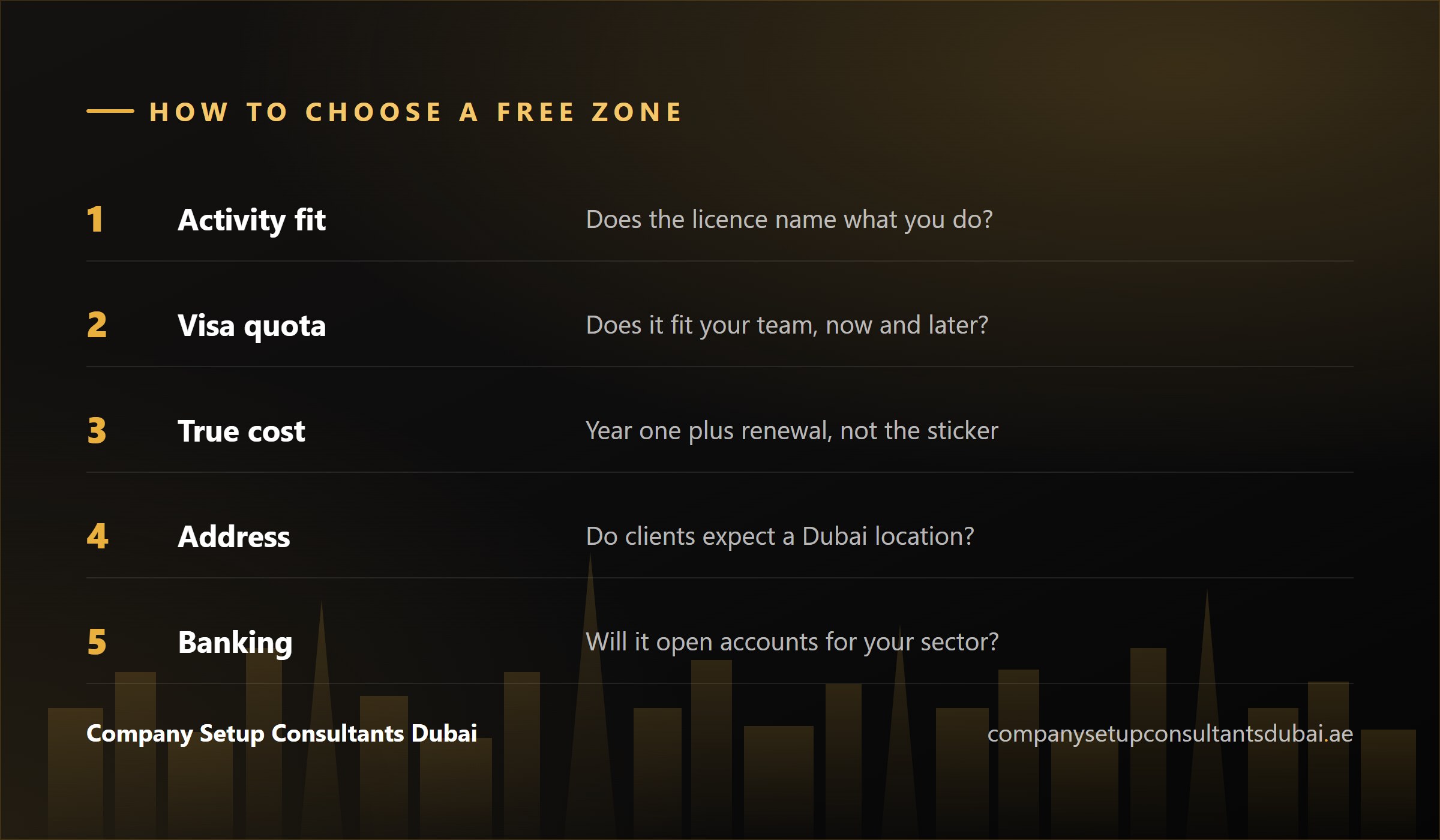
Choose on five things: does the zone's activity list cover what you do, does the visa quota fit your team, what's the true cost (year one plus renewal), does it have a Dubai address if clients expect one, and does it bank well for your sector. Cost alone is the wrong filter.
Run any zone through these five questions before you commit:
- Activity fit. Does its licence name your exact activity? A zone that doesn't cover what you do means amendments or a second licence.
- Visa quota. How many visas does the package allow, and can you grow within it? A flexi-desk usually caps you low.
- True cost. Look past year one to renewal, which is often 80-100% of the first fee, plus visa and desk costs.
- Address and credibility. Some clients and banks favour a Dubai address over a cheaper northern-emirates one.
- Banking fit. Zones like DMCC and DIFC open doors with tier-one banks; a bargain zone can make account-opening harder.
Weigh those together and the "expensive" zone sometimes turns out cheaper in the ways that count. Our business setup team maps your activity to the right zone before you pay.
Which Dubai free zones open bank accounts easily?
DMCC and DIFC have the strongest banking reputations and open tier-one accounts most smoothly. IFZA, Meydan and Dubai South bank reasonably well with mid-tier banks. The cheapest northern-emirates zones are hardest, as banks scrutinise low-cost, low-substance setups more closely. Banking fit often outweighs the licence saving.
This is the part cost-focused founders underestimate, and then spend two months on. UAE banks tightened compliance hard, and the free zone on your licence is a signal they read. A rough tiering:
- Strongest: DMCC and DIFC. Established, high-substance, recognised by every bank. Accounts open faster.
- Solid: IFZA, Meydan, Dubai South, JAFZA. Well-known Dubai zones that bank fine with the right documents.
- Harder: the cheapest northern-emirates zones. Fine for the licence, but a bank may ask more questions before approving.
None of this is a hard rule, and a clean application matters more than the zone. But if smooth banking is critical, factor it into the choice rather than discovering it after. Our corporate bank account service exists because this step trips up so many.
How much do Dubai free zones cost to run each year?
Dubai free zone licences start around AED 12,000 to AED 25,000 in year one, with renewals typically 80% to 100% of that plus office and visa costs. Add establishment card, visas at AED 3,800 to AED 6,500 each, and extra activities at roughly AED 1,000, and the running cost climbs above the headline package.
The package price is the start, not the whole bill. What lands on top:
- Renewal each year, close to the original licence fee, plus your desk or office.
- Visas at roughly AED 3,800 to AED 6,500 per person, plus renewals every two years.
- Establishment card, around AED 1,500, to register with immigration.
- Extra activities beyond the bundled ones, about AED 1,000 each.
For a full line-by-line view across mainland and free zone, we've got a dedicated guide on the cost of business setup in Dubai.
How long does free zone setup take?
Most Dubai free zone companies are ready in three to seven working days, with the fully digital zones like IFZA and Meydan at the faster end. Visas add another one to two weeks after the licence is issued. A complete, correctly spelled document pack is what keeps it fast.
Free zones are usually quicker than the mainland because the registrar, the desk and the visa quota all sit under one roof, so there's less back-and-forth. The digital-first zones can issue a licence in a couple of days when your documents are clean. The usual delays aren't the zone's fault, they're a missing passport stamp or a trade-name clash that resets the clock. Get the paperwork right and speed rarely separates one zone from another.
Do free zone companies pay tax?
A qualifying free zone company can keep a 0% corporate tax rate on qualifying income, but only if it meets the strict QFZP conditions. Non-qualifying income is taxed at 9% above AED 375,000, the same as mainland. VAT at 5% applies to any company once turnover passes AED 375,000.
The "free zone means tax-free" line needs an asterisk since the UAE introduced corporate tax in June 2023. Free zones can still offer 0%, but as a Qualifying Free Zone Person you need adequate substance in the zone, qualifying activities and proper documentation. Miss a condition and you drop to 9% like everyone else. We cover the rules on our corporate tax registration page, and VAT on the VAT filing page.
Can a free zone company sell on the Dubai mainland?
Not directly. A free zone company needs a mainland distributor, a branch, or a dual licence to sell to customers on the UAE mainland. Its own licence covers its zone and international trade only. Factor this in if any of your customers are local UAE businesses or consumers.
This limit catches people who choose a free zone purely on price and later realise they can't invoice a UAE client. The fixes exist, a distributor, a mainland branch, or a dual licence that adds local rights, but each costs extra. Better to know before you pick. Our mainland vs free zone vs offshore guide covers the workarounds in detail.
What mistakes do people make choosing a free zone?
The common mistakes are chasing the cheapest package without checking activity fit, ignoring the visa quota, overlooking a Dubai address when clients expect one, forgetting renewal and hidden costs, and picking a premium zone whose prestige they don't need. Each one costs money to fix.
A few worth naming plainly:
- Cheapest over correct. A bargain zone that doesn't name your activity, or banks poorly, isn't a bargain.
- Ignoring the visa cap. A one-visa package is fine solo, painful the day you hire.
- Overpaying for a name. DMCC and DIFC are brilliant, and wasted on a business that just needed a cheap services licence.
- Budgeting year one only. Renewals, visas and extras make the second year the real cost.
Almost all of it comes back to choosing on the sticker price instead of on how the business will actually run.
Frequently Asked Questions
What is the best free zone in Dubai?
There's no single best. IFZA and Meydan lead on low cost and flexibility, DMCC on trading and banking, DIFC on finance, and JAFZA and Dubai South on logistics. The best one depends on your activity, budget and visa needs.
Which is the cheapest free zone in Dubai?
Meydan and IFZA are the cheapest Dubai zones, from about AED 12,500 and AED 12,900. For the lowest cost overall, Shams, Ajman and RAKEZ in the northern emirates start from AED 5,750 and are usable from Dubai.
Which free zone is best for e-commerce in Dubai?
Dubai South, Dubai CommerCity and IFZA are strong for e-commerce. Dubai CommerCity is purpose-built for online retail, Dubai South adds logistics and fulfilment, and IFZA offers a low-cost e-commerce licence.
Which free zone is best for trading?
DMCC and JAFZA are the leading trading zones. DMCC suits general trading, commodities and crypto with strong banking, while JAFZA is built for logistics and large-scale trade beside Jebel Ali port.
Do free zone companies get 100% ownership?
Yes. Every UAE free zone allows 100% foreign ownership, with no local partner required. This has always been a core benefit of free zones, and since 2021 most mainland activities allow it too.
Can I get a Dubai visa through a free zone company?
Yes. Free zone companies sponsor residence visas up to a quota set by the package and office size, usually one to six. Each visa includes a medical test and Emirates ID.
Do free zone companies pay corporate tax?
A qualifying free zone company can keep 0% corporate tax on qualifying income if it meets the QFZP conditions. Non-qualifying income is taxed at 9% above AED 375,000, the same as mainland companies.
Can a free zone company do business in mainland Dubai?
Not directly. It needs a mainland distributor, a branch, or a dual licence to sell to UAE mainland customers. Its own licence covers only its zone and international trade.


